
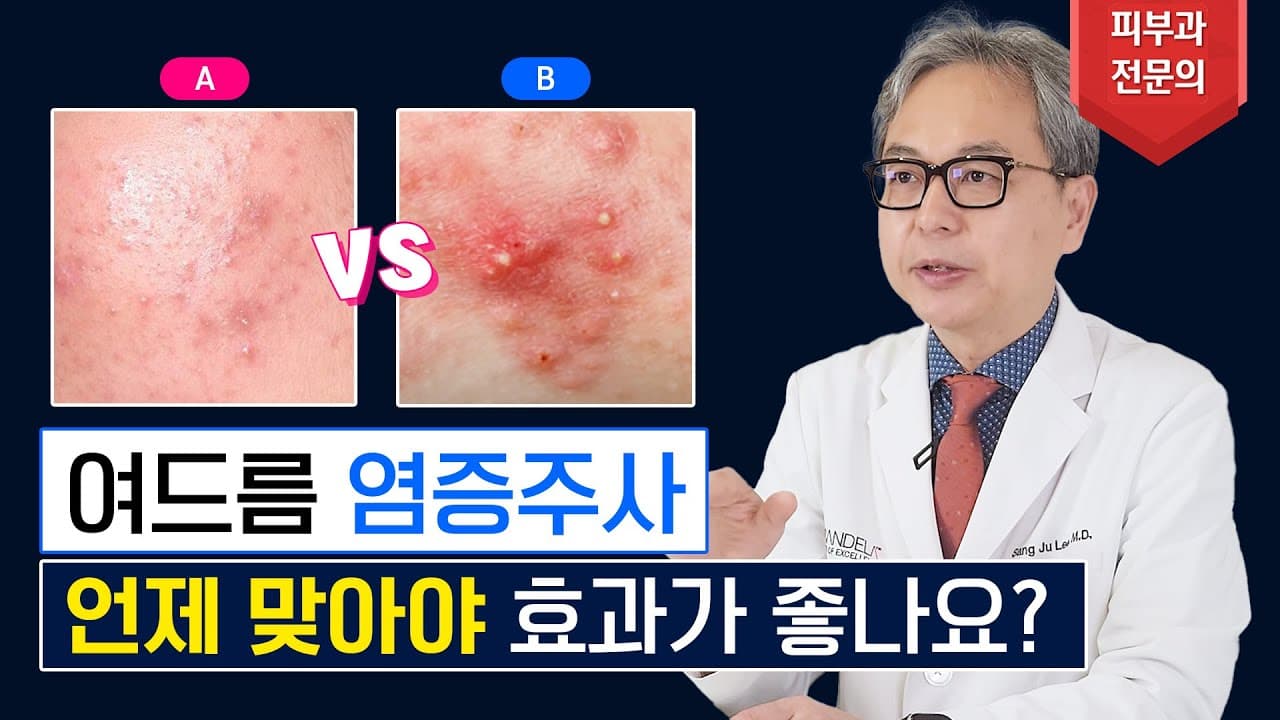
Hello. I am Dr. Lee Sang-ju, a dermatologist.
When sudden red, painful inflammatory acne appears on the face, many people consider anti-inflammatory injections. However, it is not uncommon for the skin to become indented after an anti-inflammatory injection, causing concern. Today, we will take some time to address your questions about the ingredients and effects of acne anti-inflammatory injections.
When is an acne anti-inflammatory injection necessary?
Not all acne requires an anti-inflammatory injection. Generally, when acne is painful or the inflammation is severely swollen, active treatment to reduce the inflammation is needed. One of the representative treatments at this time is the acne anti-inflammatory injection.
Main ingredients and effects of anti-inflammatory injections
The main ingredient in acne anti-inflammatory injections is steroid. While there are various types of steroids, triamcinolone is typically used. These medications have excellent anti-inflammatory effects that quickly reduce inflammation.
When a small amount of medication is injected into the inflamed acne area, it helps to reduce inflammation and prevent the acne from progressing further. As a result, it can be expected to partially prevent the progression to acne scars.
Is an anti-inflammatory injection effective for all types of acne?
Acne can be broadly divided into inflammatory and non-inflammatory types. As the name suggests, an anti-inflammatory injection reduces inflammation, so it does not show significant effects on non-inflammatory acne.
- Non-inflammatory acne: Comedonal acne or comedones are typical examples. In these cases, since there is no inflammation, anti-inflammatory injections are unlikely to be very effective.
- Old acne: If the inflammation has been present for a long time and has hardened, the effect of the injection may be reduced.
When do the effects of an anti-inflammatory injection appear?
Generally, after receiving an acne anti-inflammatory injection, you may feel the redness or pain of the acne subside within 2-3 days. However, there may be individual differences depending on the condition of the acne.
Can anti-inflammatory injections be repeated?
If acne inflammation is very severe, the treatment can be repeated, though not frequently. It can also be used to reduce inflammation when acne continuously appears in a specific area and the inflammation worsens.
However, it is not recommended to receive injections too frequently or multiple times in areas with little to no inflammation.
Why does skin indentation occur after an anti-inflammatory injection?
There are cases where people feel their skin has become indented after an anti-inflammatory injection. This can be attributed to three main reasons:
- Severe inflammation: If the acne inflammation is too severe, the anti-inflammatory injection alone may not completely control the inflammation, eventually leading to acne scars.
- Medication spreading to surrounding skin: If acne inflammation is connected not only to the pore area but also to the surrounding skin, the inflammation will subside after an anti-inflammatory injection, but some medication may spread sideways, causing a slight indentation.
- Injection into a different area: Rarely, indentation can occur if the injection is given to an area other than the inflamed site, but for dermatologists with extensive experience in anti-inflammatory injections, the first two cases are most common.
Can skin indentation recover?
Generally, skin indentation after an anti-inflammatory injection often returns to normal over time as the effect of the medication wears off. However, if recovery is slow, treatments such as saline solution or collagen boost may be considered to attempt improvement.
Skin indentation after an anti-inflammatory injection often recovers naturally over time, but if recovery is slow, you can consult with medical staff to consider appropriate measures.
We hope today's video helped answer your questions about acne anti-inflammatory injections.