
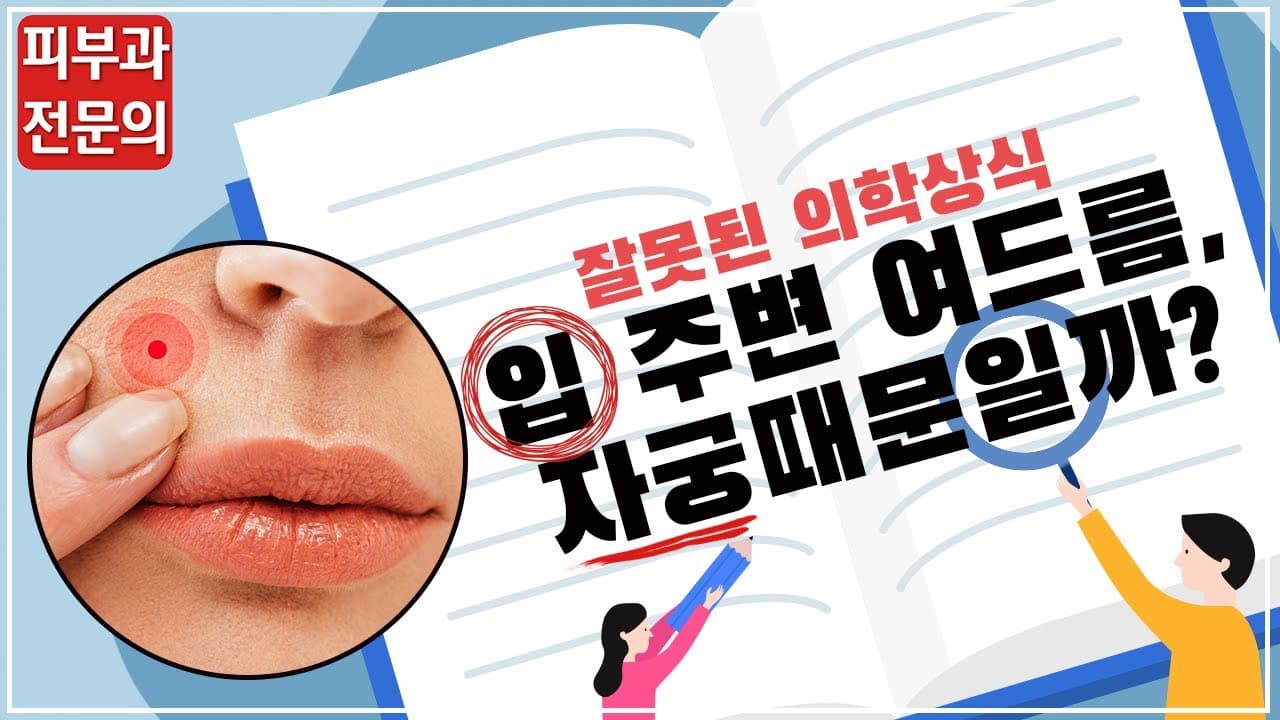
Commonly Misunderstood Medical Facts, Corrected by a Dermatologist
Hello. I am Dr. Ji-in Jung, a dermatologist. Today, I would like to discuss medical facts that many people surprisingly misunderstand.
Is Perioral Acne Caused by the Uterus?
Perioral acne is common in women aged 20 to 40, a higher age group than those who typically experience forehead acne. It is known to be associated with hormonal changes during the menstrual cycle.
I often receive questions asking if it is caused by heat in the uterus. However, the uterus is not an organ that directly produces hormones. It can be seen as being related to the ovarian cycle rather than the uterus.
In most cases, when examined by an obstetrician-gynecologist, there are often no particular abnormalities.
However, if acne is severe not only around the mouth but also generally, and if acne appears on the arms or chest along with increased fine hair, it may be related to relatively common gynecological conditions such as Polycystic Ovary Syndrome, and should be suspected.
Can Ear Piercings Cause Blindness?
Earlobe piercings do not cause blindness. The optic nerve does not pass through the earlobe, and it is uncommon for the eye itself or the optic nerve to be directly penetrated like a gunshot, so it is difficult for them to be damaged by ear piercing.
Theoretically, it might be possible if somewhere along the path where visual stimuli travel and the optic nerve bundles run were accidentally destroyed during piercing, but this is considered almost impossible.
Is There Poison Ivy in Hair Dye?
Hair dye does not contain poison ivy. Many people think they are experiencing a poison ivy rash because when they think of allergies, poison ivy allergy often comes to mind first. The incidence of poison ivy allergy is also very high.
Hair dye allergies often present with symptoms similar to poison ivy allergies. They usually appear in the form of contact dermatitis, such as weeping or red spots, so when looking for the cause, they can appear incomparably similar.
In the real world, poison ivy is not the only cause of allergies. Although less frequent than poison ivy, hair dye also tends to cause allergies. Among hair dye ingredients, the one that causes many allergies is mainly PPD (paraphenylenediamine). It may also be labeled as PPD or PDA. In addition, irritant contact dermatitis caused by ammonia is also common.
Both are completely different ingredients from poison ivy.
Is Low Blood Pressure Always Dangerous?
I cannot say that low blood pressure is 100% dangerous. Cases where it can be life-threatening due to specific diseases are as follows:
- Orthostatic hypotension: A phenomenon where blood pressure drops when suddenly standing up after squatting or lying down. There is a risk of dizziness or falls.
- Cardiogenic shock, septic shock, etc.
However, not all individuals with simply low blood pressure are classified as having a disease. In fact, there are stories that many long-lived individuals have low blood pressure.
If orthostatic hypotension is severe, it is advisable to develop a habit of standing up while holding onto a safe handrail, and if necessary, it is important to consult an internal medicine specialist.
Why Do Genetic Diseases Occur Without a Family History?
Genetic diseases can occur even without a family history. This can be broadly divided into three cases:
-
Autosomal recessive genetic diseases:
- Parents carry the gene but do not show symptoms; they are healthy carriers.
- A recessive gene is not an inferior gene, but one that does not show symptoms when it is present with a dominant gene that can compensate for its deficient function.
- The child develops the disease when they inherit one unhealthy recessive gene from each parent.
- If two healthy carriers meet, 1 in 4 of their children may inherit the gene and show symptoms. If the symptoms are severe, stillbirth or failure to be born may occur.
- This is also why various genetic diseases are relatively common in Arab countries where consanguineous marriages are frequent.
-
X-chromosome abnormalities (sex-linked genetic diseases):
- Males are easily affected, but females have a high probability of not showing symptoms even if they carry the gene.
- This is because females have an extra X chromosome.
- Women who are carriers of diseases such as hemophilia or color blindness can give birth to sons with the disease without showing any symptoms themselves.
- Even if the father is normal, if only the mother is a carrier, half of the sons will develop the disease.
- If a colorblind father and a colorblind carrier mother meet, half of their daughters will be colorblind, and the rest will be carriers.
-
Occurrence due to mutation:
- There are diseases that cause disorders in the nervous system and skin, such as neurofibromatosis.
- It is a relatively common disease, occurring in about 1 in 3,500 people.
- About one-third of patients with this disease develop it due to a genetic abnormality that did not exist in previous generations, becoming the progenitor of the disease themselves.
- If it were present in the parents, it would be a dominant disease where symptoms could not be absent.
- Once it develops, since it is an autosomal dominant disease, there is about a 1 in 2 chance of it being inherited by children.
Today, I have discussed medical facts that many people misunderstand. If there are any topics you would like me to cover, I will refer to them for content creation within my knowledge.