
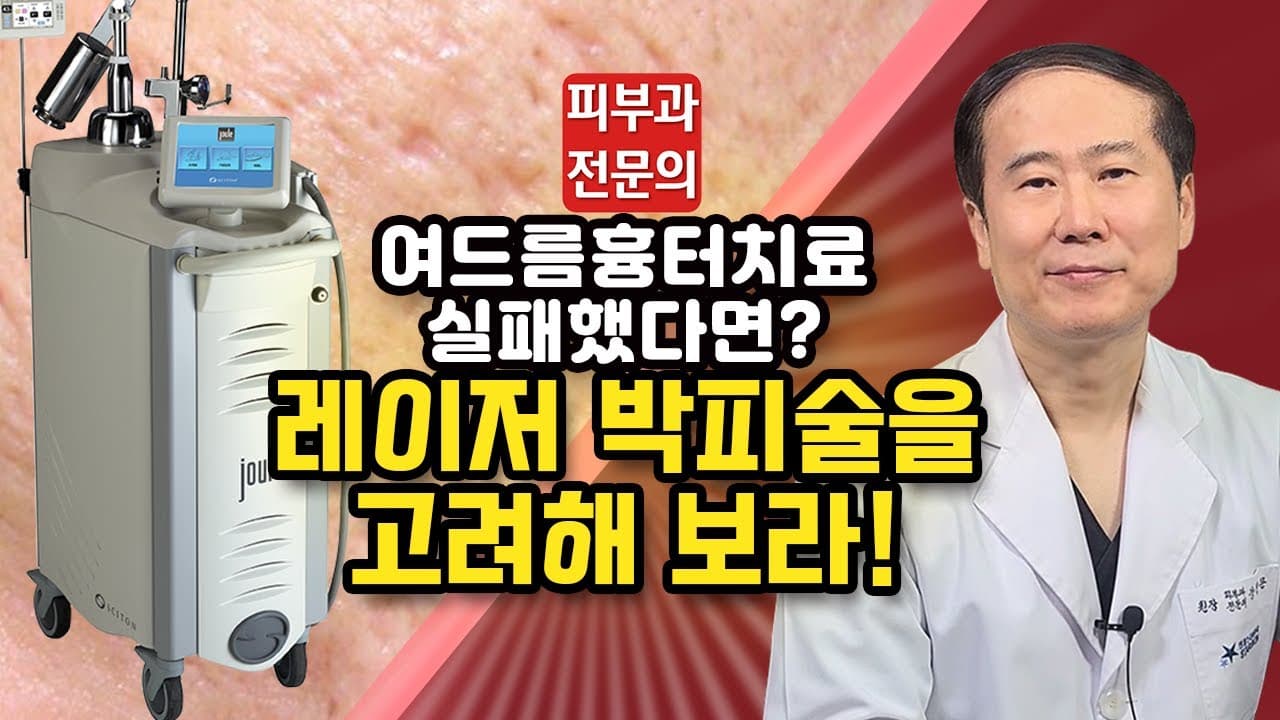
Hello, I am dermatologist Kang Ji-moon. Last time, I introduced three methods for treating severe acne scars. Today, we will take a closer look at laser dermabrasion among them.
What is Laser Dermabrasion?
Laser dermabrasion is, literally, a method of abrading the skin to a certain depth. Its origins can be traced back to chemical peels performed for about 100 years, and it was known early on that artificially peeling the skin could induce skin regeneration.
About 30 years ago, as laser technology began to develop, laser dermabrasion started to be widely used for wrinkles, scars, and anti-aging. Currently, it is mainly used for treating stubborn acne scars, and tends not to be used much for anti-aging purposes.
Erbium YAG laser is mainly used for this procedure, and the depth can be adjusted in various ways according to the practitioner's judgment. The deeper the depth, the stronger the treatment effect, but the risk of side effects may also increase. If the depth is shallow, the treatment effect may be relatively lower, but the risk of side effects may be lower.
Which Acne Scars are Suitable for Laser Dermabrasion?
Not all acne scars require laser dermabrasion. This procedure is considered in the following cases:
- Severe acne scars
- Acne scars that have not improved with other treatments
This is because laser dermabrasion involves considerable discomfort during post-procedure care, requires a recovery period (downtime), and carries some risk of side effects. Regardless of the scar shape, it can primarily help with severe acne scars. If severe scars are alleviated after 1-2 sessions of laser dermabrasion, customized treatment can then be performed according to the scar shape.
For example, Dot Peeling can be helpful for icepick scars or boxcar scars, while Subcision or filler injections may help with rolling scars.
Does Laser Dermabrasion Make Skin Like Porcelain?
No, it does not. Laser dermabrasion is different from simply smoothing the skin surface like planing wood.
While it does abrade the skin, it doesn't end there. The abraded area regenerates to the extent of normal skin, and the scar area regenerates further, working to smooth out the difference in layers between normal skin and the scar area.
Laser dermabrasion works by inducing the depressed scar area to regenerate more than the surrounding normal area, thereby reducing the difference in level between normal skin and the scar. As a result, the overall skin can be expected to become thicker and healthier.
How Does the Skin Change After the Procedure?
Immediately after the procedure, the skin may temporarily become sensitive. This is because it takes more than a year for the skin to fully regenerate and return to its original state after being completely abraded. Of course, it may appear normal to the naked eye within a few months, but it takes more than a year to return to 100% normal function. Therefore, the skin may feel sensitive until full recovery.
Post-Procedure Care and Recovery Process for Laser Dermabrasion
Immediately after laser dermabrasion, oozing and blood may appear, so the entire face must be dressed for about a week.
After a week, the dressing can be removed, and pink new skin begins to appear. During this period, the skin is very sensitive, so it is important to avoid physical and chemical irritation as much as possible. Light showering, daily activities, and makeup are possible.
About a month later, pigmentation may occur. Although there are individual differences, generally, some brown pigment may newly appear and last for about 6 months.
It takes approximately more than a year for the peeled skin tissue to fully regenerate, and the maximum treatment effect can also be felt only after a year.
What About Pain and Number of Sessions?
The pain of laser dermabrasion is quite severe, so sufficient anesthesia is essential. Usually, cream anesthesia needs to be applied for more than 2 hours.
The number of treatments varies depending on the severity of the acne scars. In severe cases, 2-3 sessions may be necessary, and after that, other general treatment methods can be used to supplement.
Today, we learned more about laser dermabrasion. Deep laser dermabrasion is known to be an effective procedure for very severe acne scars.
However, it is a high-difficulty procedure that requires the medical staff to delicately manage potential side effects, so it is crucial to consult sufficiently with an experienced dermatologist before deciding on treatment. If you have any questions, please feel free to ask.