
![[Yonsei Star Dermatology Sinchon] Scar-Free Wound Management - JoongAng Ilbo Interview / Sinchon Station Dermatology](/_next/image?url=https%3A%2F%2Fagqdgbuateknhwpocrgu.supabase.co%2Fstorage%2Fv1%2Fobject%2Fpublic%2Fsources%2Fbbf3bebe-45b6-4415-bd04-bda18b2cac0f%2Fblog-images%2F223039632945_00_b793b97e5209.png%3Ftype%3Dw966&w=3840&q=75)
The wound healing process may seem similar for everyone, but for wounds of the same size, some people heal cleanly while others are left with long-lasting scars. The most important point is that how you manage a wound immediately after injury determines the fate of the scar.
An interview with Dr. Lee Sang-Joo, Chief Director of Yonsei Star Dermatology Sinchon, was published in the JoongAng Ilbo print and online on March 6th. The topic was scar-free wound management, and it included discussions on common misconceptions about wound care habits and approaches to treating existing scars.
Scars are determined in the first stage of wound management
Although scars seem to appear after a wound has healed, their trajectory is often set during the first few days of management immediately after the injury. If the wound area maintains an appropriate environment during skin regeneration, the scar may remain faint; otherwise, even the same wound can leave a deep mark.
In the clinic, we often see that many patients who visit us with scar concerns made regrettable choices during the initial wound management stage. Small differences can lead to significant differences in the marks left on the skin months later.
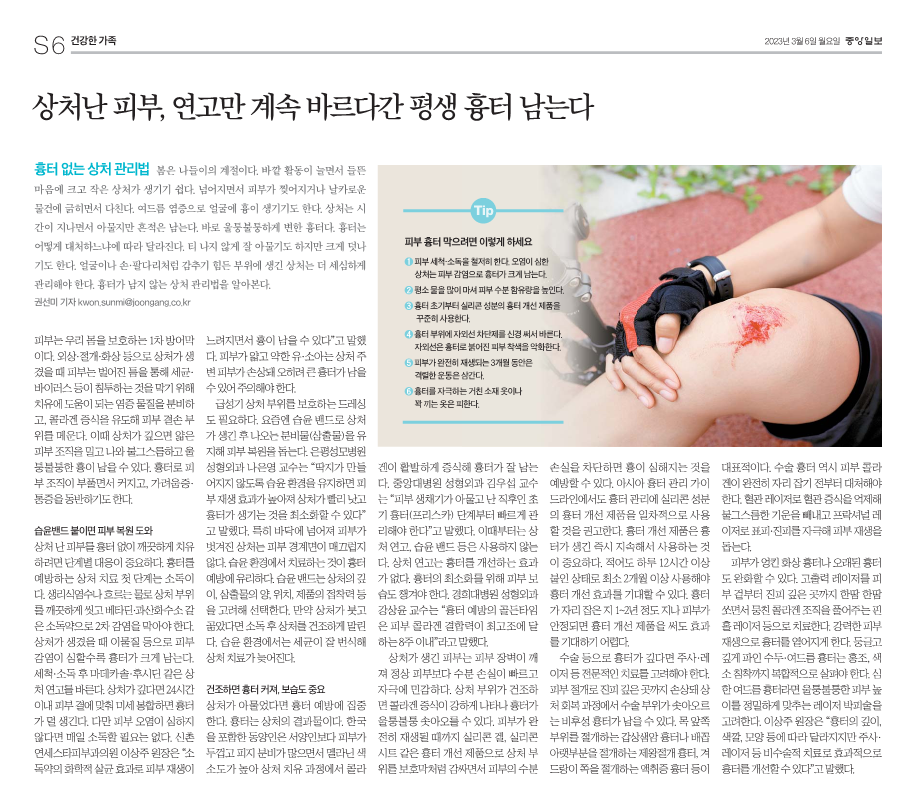
Is using disinfectant always the right answer?
When an injury occurs, many people reflexively reach for disinfectant. However, Dr. Lee Sang-Joo advised in the interview that improper use of disinfectants could actually lead to scarring. This is because strong disinfectant ingredients can irritate not only bacteria but also newly growing skin cells.
Improper use of disinfectants may result in scarring.
Rather than vague reliance on disinfection, wound management tailored to the wound's condition is a more effective way to reduce scarring.
Good wound care habits to follow in daily life
Immediate post-injury care is less about elaborate treatments and more about the accumulation of small habits. If you wish to minimize scarring, it is good to remember the following points:
- Do not carelessly touch the wound or forcibly remove scabs.
- Do not habitually overuse disinfectants.
- Maintain an appropriate moist environment to prevent the wound area from becoming excessively dry.
- Cover the wound to avoid prolonged exposure to sunlight.
- For deep or large wounds, do not insist on self-treatment; seek medical attention.
These habits can help reduce scarring without special equipment. However, the direction of care may vary depending on the depth and location of the wound, so it is safer to seek professional help when judgment is difficult.
If you have further questions about wound care, you can easily ask through Scar Wound Care Chat Consultation.
What about existing scars, and old scars?
Once a scar has formed, it is difficult to reverse it with wound management alone. Based on over 20 years of scar treatment experience, Dr. Lee Sang-Joo introduced treatment approaches applicable to both existing and old scars in the interview.
Scars do not appear in just one form. The approach varies depending on the type, so understanding which type your scar is closest to is the starting point.
| Scar Type | Characteristics |
|---|---|
| Surgical Scar | Marks remaining along the surgical incision line |
| Burn Scar | Deformities or marks remaining after a burn has healed |
| Keloid Scar | Scars that grow prominently beyond the original wound boundary |
| Depressed Scar | Scars that remain as indentations where the skin has sunken |
Depending on the type, the approach differs, such as for Surgical Scar or Burn Scar, and prominent Keloid Scar requires different management. Existing scars may also be treated with methods like Surgical Scar Revision.

When is the best time to start scar treatment?
Delaying scar treatment can sometimes lead to the scar becoming more firmly established. While it is not impossible to treat old scars, the recovery pattern may vary individually depending on the condition.
Since the treatment approach varies depending on the depth, location, time of formation, and skin characteristics of the scar, it is important to accurately assess your condition first, rather than applying a single predetermined answer. Instead of vaguely waiting without a diagnosis, it can be helpful to have your condition checked at some point.
If you are concerned about the timing or method of scar treatment, we recommend receiving guidance tailored to your condition through Scar Treatment Chat Consultation.
If you are curious about the full interview
More detailed methods for scar-free wound management can be found in the original JoongAng Ilbo article.
Original article link: https://www.joongang.co.kr/article/25144693
Please remember that small differences in wound care can make a difference in the marks left on the skin, and that it is too early to give up on existing scars.
Chief Director Lee Sang-Joo (MD, PhD, Yonsei University College of Medicine and Graduate School, completed dermatology residency at Severance Hospital, President of the Korean Dermatological Association) Chief Director Lee Sang-Joo's Profile First published 2023-03-09 / Last reviewed 2026-06-16
This article is for general informational purposes only, and the appearance of wounds and scars may vary individually. Accurate diagnosis and treatment should be determined through consultation with medical professionals.