
![[Yonsei Star Dermatology Sinchon] Effective Care for Wrist Self-Harm Scars: Laser Methods to Alleviate Self-Inflicted and Hesitation Marks](/_next/image?url=https%3A%2F%2Fagqdgbuateknhwpocrgu.supabase.co%2Fstorage%2Fv1%2Fobject%2Fpublic%2Fsources%2Fbbf3bebe-45b6-4415-bd04-bda18b2cac0f%2Fblog-images%2F224194191006_00_b7602a1a54e5.jpg%3Ftype%3Dw966&w=3840&q=75)
Scars left in a linear form on the inner wrist often go beyond simple skin marks, carrying a significant emotional burden. Many individuals visit the clinic with the question, "Can existing self-harm scars fade naturally, even now?" To answer directly, while it's difficult to erase them completely as if they never existed, treatment to restore them to a point where they are barely noticeable at a glance is certainly possible.
Why are wrist self-harm scars particularly noticeable?
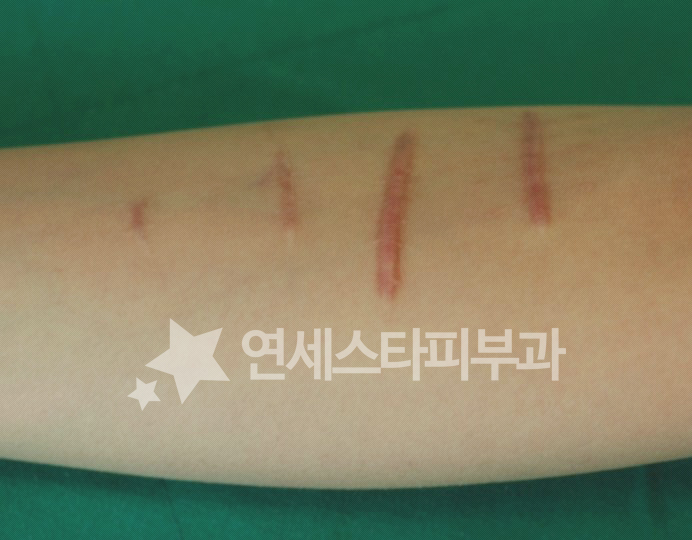
Wrist self-harm scars, also known as hesitation marks, are characterized by multiple layers of linear marks resulting from repeated injury to the same area. Often accompanied by psychological instability, damage may be inflicted again before the skin has fully recovered.
During this process, the depth of the scars becomes inconsistent, with some remaining as raised forms and others as whitened, depigmented forms. The greater the difference in surface height and color from the surrounding skin, the more prominent the marks appear.
The goal of scar treatment is not to completely eliminate traces, but to blur the boundaries with the surrounding skin, allowing them to blend in naturally.

Marks leave more than just skin deep impressions
The marks left on the wrist are not just an aesthetic issue. They can lead to concerns about others' perceptions, feelings of shrinking, and decreased self-confidence, and in severe cases, can significantly impact daily life.
Therefore, the treatment of self-harm marks requires a perspective that views it not merely as a dermatological procedure, but as a process of recovery to return to daily life. Often, as the marks fade, a sense of relief follows, allowing individuals to no longer feel the need to hide themselves.
We accurately categorize scar types first
Before beginning laser treatment, it is essential to first distinguish the nature of the remaining scars, as the approach varies depending on their form.
| Scar Type | Visible Characteristics | Considerations in Treatment |
|---|---|---|
| Raised form | Protrudes and is palpable compared to surrounding skin | Aim to match surface height with surrounding skin |
| Whitened form | Pigment is lightened, appearing as white lines | Adjust skin tone to be closer to surrounding skin |
| Deeply indented form | Sinks inward along the line | Gradually induce tissue to fill in |
It is common for these forms to be mixed on the same wrist, so determining the order in which to address each area will influence satisfaction.
Laser treatment is not a one-time procedure
In the clinic, the most common misunderstanding is regarding the number of sessions. Laser scar treatment is not a one-time procedure, but a process of gradually building up tissue and progressively matching skin tone to refine the appearance more naturally.
Depending on the condition, it may require 5 or more sessions, and in some cases, even 10 or more, meaning the treatment period can be longer than expected. Nevertheless, if you persevere without giving up midway, you can expect results that reduce the stress caused by hesitation marks.
Here are some important points to check during the process:
- Manage to prevent new injuries to the same area during treatment.
- Understand that it is a process of gradual change and do not give up midway.
- Adhere to post-care, including recovery periods between sessions and sun protection.
- If scar forms are mixed, approach them in stages according to priority.
- Be patient with yourself, even during periods when changes are slow.
If you have similar concerns, you are welcome to inquire about laser methods for different scar types via chat consultation.

Treatments considered together depending on the scar type
Wrist scars are not approached with a single method. If there is a tendency towards raised hypertrophic or keloid scars, Triamcinolone Scar Injection may be considered. If the lines are wide or deep, Surgical Scar Revision may be discussed.
For scars remaining after surgery or cosmetic procedures on areas other than the wrist, the approach also varies depending on the form, so the process of first identifying the nature of the marks remains the same.
Reconsider covering up
Some people consider covering up the marks quickly by getting cover-up tattoos or wearing clothes. However, temporary concealment often leads to dissatisfaction, and if a tattoo is applied, the treatment difficulty can actually increase later on, as it may involve an additional step of tattoo removal along with the scar.
If you are going to start, it is generally less burdensome in the long run to first explore methods that lighten the marks themselves rather than just covering them.

Recovery is a collaborative process
Satisfaction with the improvement of wrist self-harm scars ultimately depends on two factors. One is accurately categorizing the scar forms and planning which areas to treat and how, and the other is the consistency in adhering to that plan until the end.
As this is an area that is difficult to assess alone, we recommend starting by checking your condition together with medical staff. While there may be individual differences in the extent and speed of change, we can work together to find a direction that helps you live your daily life without being bound by the marks.

Chief Director Lee Sang-Joo (MD, PhD, Yonsei University College of Medicine & Graduate School, Completed Dermatology Residency at Severance Hospital, President of the Korean Dermatological Association) Chief Director Lee Sang-Joo's Profile First Published 2026-02-24 / Last Reviewed 2026-06-16
This content is for general information purposes only. As scar conditions and treatment responses can vary individually, please consult with medical staff for an accurate diagnosis and treatment plan.