


Compared to the past, the scope of tattoo and permanent makeup use has expanded. Not only are more people getting lettering, patterns, and drawings, but also many are using it semi-permanently for things like eyeliner or eyebrows.
As the number of users has increased, so has the number of people who are stressed by existing marks on their bodies and wish to remove them.
How Lasers Treat Pigment
Currently, the most widely used method is laser removal. Lasers finely destroy the ink pigment embedded in the skin, making it easier for the body to expel.
At this time, it is necessary to consider the type of equipment suitable for removal, the density and color of the ink pigment absorbed into the skin, and the skin characteristics of the person seeking removal.
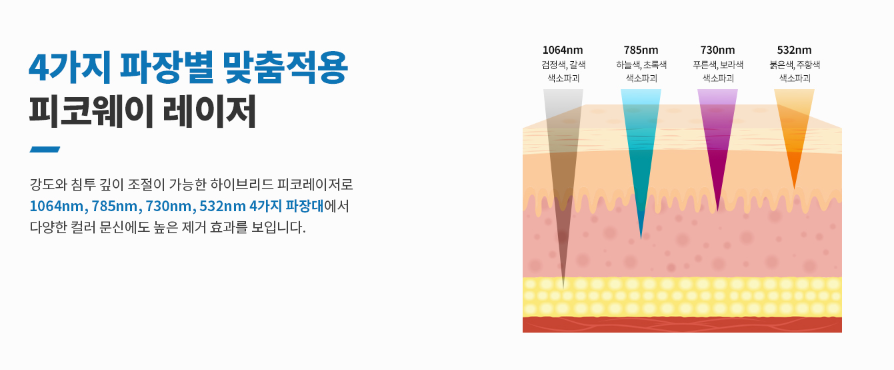
Why the Process Takes Several Months
Tattoo removal is a considerably time-consuming process. Depending on the individual's condition, the skin stimulated by laser treatment may experience swelling and redness. It is important to choose safe equipment, laser methods, and treatment duration while considering these factors.
While laser treatment can remove pigment relatively quickly, realistically, you should expect several months to as many as 1-2 years.
Rather than expecting quick results in one go, it is better to proceed without overdoing it, checking the skin's changes and safety throughout the process.

Changing Conditions Due to Complex Inks
- The composition of inks has become more diverse.
- The density has become very high, leading to many very dark tattoos.
- There has been an increase in cases where various inks are mixed for subtle colors and natural hues.
Consequently, the difficulty of removal is becoming increasingly challenging.
How to Address Challenging Conditions
In such situations, choosing the right place for the procedure becomes crucial to safely remove tattoos while reducing the likelihood of scars or other side effects. Fortunately, equipment has also evolved.
Lasers like PicoWay can utilize up to four wavelengths to flexibly respond to various colors, and it is also possible to combine it with the Pinhole Technique, which stably reduces the possibility of scars that may occur during the procedure. You can find the details in the R-Zero Pico-Frectat Tattoo Removal guide and the Pinhole for Burn & Surgical Scar treatment guide.

What to Check at Each Stage
| Stage | What to Check |
|---|---|
| Before treatment | Comprehensive consideration of equipment type, pigment density and color, and individual skin characteristics |
| During treatment | Proceed while checking skin changes such as swelling and redness, and ensuring safety |
| After treatment | Avoid direct sun exposure and adequately apply regenerative cream and moisturizing care |
Protecting dry skin from repeated laser treatments helps manage it to prevent pigmentation or scarring, and also increases satisfaction with the results.
Things to Prepare Before Starting
Organizing information about the color, density, area, and current skin condition of the tattoo you wish to remove will facilitate consultation. The procedure order is available in the Tattoo Removal Treatment Guide, and if you are curious about how long your tattoo might take to remove, you can inquire via chat now.
Authored · Medically Reviewed by Dr. Jinmun Kang, Chief Director (Dermatologist) Graduated from Yonsei University College of Medicine · Severance Hospital Dermatology Resident Served as Professor at Bundang CHA Hospital · Member of the Korean Medical Laser Association View Medical Staff Profile
First Published 2026-02-04 · Last Reviewed 2026-07-29
This article contains general medical information and does not substitute for individual diagnosis and treatment. Results and recovery progress may vary by individual.