
![Why is the choice before treatment important for seborrheic keratosis? | [Yonsei Star Dermatology Sinchon]](/_next/image?url=https%3A%2F%2Fagqdgbuateknhwpocrgu.supabase.co%2Fstorage%2Fv1%2Fobject%2Fpublic%2Fsources%2Fbbf3bebe-45b6-4415-bd04-bda18b2cac0f%2Fblog-images%2F223946898377_00_969e5a39fcf8.jpg%3Ftype%3Dw966&w=3840&q=75)
If you've noticed one or two brown spots, like moles, appearing on your face, hands, or arms while looking in the mirror, you might suspect seborrheic keratosis. The first question that comes to mind is usually similar: "Will this go away on its own, or do I need laser removal?" To cut to the chase, seborrheic keratosis tends not to disappear on its own over time and increases in number, so it's best to consider diagnosis and treatment together, tailored to your condition.
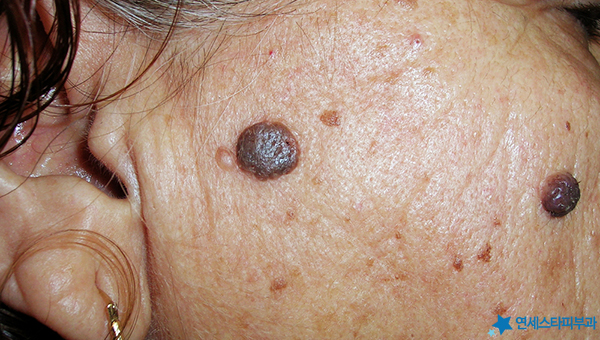
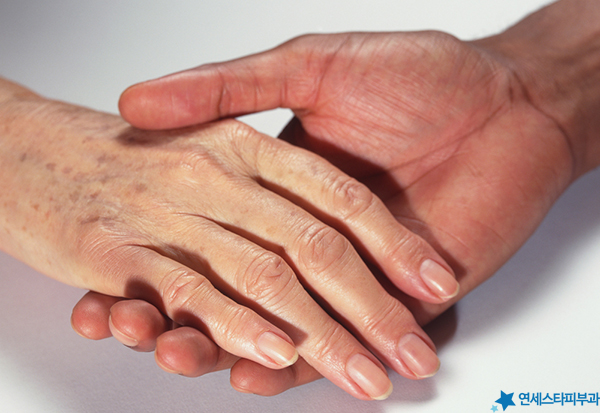
Seborrheic keratosis is a pigmented lesion that commonly appears on areas frequently exposed to UV light, such as the face, back of the hands, and arms. It often presents as a raised, dome-shaped lesion on the surface, characterized by its thickness, unlike typical moles.
Why doesn't seborrheic keratosis disappear on its own?
Seborrheic keratosis differs in nature from what are commonly called moles. It is classified as a type of benign tumor resulting from the abnormal proliferation of the skin's epidermal layer. Even if it looks like an ordinary mole to the naked eye, it often has thickness and a dark color, making it more noticeable over time.
In particular, seborrheic keratosis can be more than 100 times thicker than the epidermis, making it a challenging pigmented skin condition for laser procedures. Since it's not a lesion that simply deals with shallow surface pigment, an approach that considers both thickness and depth is necessary.

Seborrheic keratosis is a pigmented lesion caused by benign epidermal proliferation, so it has thickness and is difficult to treat in the same way as common moles.
Is it okay to remove it with home care?
There is a lot of information available about removing seborrheic keratosis through folk remedies or home care. However, caution is needed as there is a risk of leaving behind hyperpigmentation or scars, depending on skin type and lesion thickness.
In the clinic, we often see cases where people visit after attempting to forcefully scratch or remove lesions with chemicals at home, resulting in marks. Here are some points to check before attempting self-removal:
- It can be difficult to distinguish between ordinary moles, seborrheic keratosis, and other pigmented lesions by visual inspection alone.
- The thicker the lesion, the higher the risk of hyperpigmentation during self-removal.
- Excessive irritation can lead to scarring.
- If the nature of the lesion is suspicious, diagnosis should precede arbitrary removal.
Therefore, many people choose an approach like Epidermal Pigment Removal for spots, seborrheic keratosis, and freckles, where the lesion's condition is diagnosed before determining the treatment direction. An experienced dermatologist will meticulously examine the lesion and suggest an appropriate method.
Why RePott Laser is used for seborrheic keratosis treatment
Recently, RePott Laser is widely used for treating stubborn pigmented lesions, including seborrheic keratosis. RePott Laser is a device that precisely irradiates high-output energy onto the lesion to treat seborrheic keratosis.
Conventional devices like laser toning or IPL often require gradual treatment even for shallow pigment due to their low-output characteristics, making it difficult to remove in one go. In contrast, RePott Laser can output strong energy even if the lesion's thickness and depth are considerable, and it is reported that improvement can be expected with fewer treatment sessions.
Furthermore, it precisely targets the lesion with a handpiece equipped with a built-in camera, which helps reduce the impact on surrounding healthy skin, lowering the risk of side effects and irritation. It is equipped with a high-performance cooling system to stably protect the skin during the procedure, and the recovery period is relatively short. After the actual procedure, the lesion naturally falls off within 1-2 weeks, and a regenerative band like DuoDERM is applied to aid wound healing.
If you have any questions, please feel free to leave them via chat consultation regarding seborrheic keratosis treatment methods.
Before and after treatment, please observe these points
If you are considering RePott Laser treatment, it's good to remember a few precautions. Small habits during the recovery process can affect the outcome.

- Avoid sun exposure before and after the procedure, and consistently use sunscreen.
- If scabs or dead skin cells form on the lesion, do not forcibly remove them; wait for them to fall off naturally.
- During the recovery period, avoid strong irritants like scrubs, peels, and saunas.
- Protect your skin sufficiently with moisturizers and calming creams.
UV protection is especially important as UV rays can worsen hyperpigmentation. Forcibly removing scabs can lead to scarring, so waiting for them to naturally detach is beneficial for recovery.
Will it be over in one session, and how many sessions will it take?
One of the most frequently asked questions during seborrheic keratosis consultations is, "Will it disappear with just one session?" While RePott Laser is a device that can achieve noticeable changes with relatively few sessions, it's good to keep in mind that the number of sessions may increase depending on the shape, size, and depth of the seborrheic keratosis.
Especially for raised seborrheic keratosis, excision, which physically shaves off the lesion, may be combined with simple laser treatment. For such lesions, an approach that considers the shape, such as Laser Lesion Removal for moles, syringomas, and warts, can be helpful. Afterward, combined treatment, such as Customized Whitening Solution or laser toning, may be necessary to prevent hyperpigmentation and recurrence.
| Seborrheic Keratosis Type | Considered Approach |
|---|---|
| Thin, flat pigmented type | Primarily laser monotherapy |
| Thick, raised elevated type | Excision may be considered |
| Concern for recurrence/hyperpigmentation | Combined whitening/toning care |
Long-term skin care over short-term procedures
Therefore, rather than simply choosing a treatment location just because it has the equipment, it is important to receive diagnosis and treatment from a place with experienced dermatologists. This is because seborrheic keratosis is a pigmented skin condition that can become more prominent over time and affect one's appearance.
With precise diagnosis and appropriate ongoing treatment, you can expect changes such as lighter pigment and a brighter skin tone. However, the degree of improvement and recovery patterns may vary individually, so establishing a plan tailored to your condition is paramount.

If you are concerned about the direction or number of seborrheic keratosis treatments, we recommend getting a diagnosis first rather than making a self-assessment.
💬 Chat for consultation now

Chief Director Lee Sang-ju (MD, PhD, Yonsei University College of Medicine and Graduate School, completed dermatology residency at Severance Hospital, President of the Korean Dermatological Association) Chief Director Lee Sang-ju's Profile First published 2025-07-25 / Last reviewed 2026-06-16
The shape and skin condition of seborrheic keratosis vary from person to person, so please ensure an accurate diagnosis and treatment plan through consultation with medical staff.