
![Why Do Breast Augmentation Scars Form Easily and When Is the Right Time for Treatment? | [Yonsei Star Dermatology Sinchon]](/_next/image?url=https%3A%2F%2Fagqdgbuateknhwpocrgu.supabase.co%2Fstorage%2Fv1%2Fobject%2Fpublic%2Fsources%2Fbbf3bebe-45b6-4415-bd04-bda18b2cac0f%2Fblog-images%2F223760731860_00_17327f382f00.jpg%3Ftype%3Dw966&w=3840&q=75)
Hello, this is Yonsei Star Dermatology Sinchon.
Many people find themselves pausing in front of the mirror because of marks left at the incision site after breast augmentation. Skin incision is an unavoidable process for inserting implants, and how these remaining marks are managed ultimately determines satisfaction. The most common question is usually one: "Can this scar be treated, and when should I start?"
Breast augmentation often leads to satisfaction by changing the line and volume. However, the process of inserting artificial implants involves skin incisions, and scars can remain at these incision sites. In this article, we will systematically explain why these marks appear and when is the best time to address them.
Where are the incisions made, and why do marks remain there?
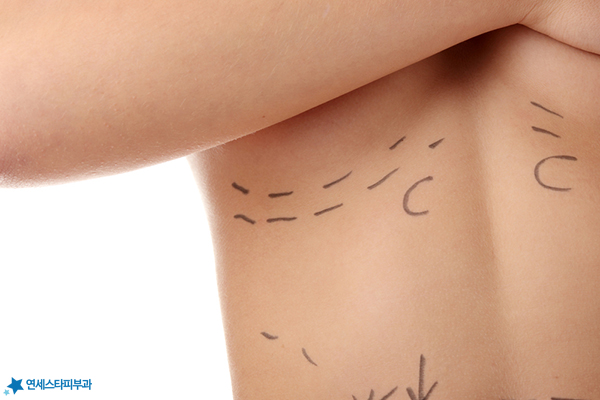
During surgery, incisions are made in areas that are as inconspicuous as possible. Common locations include the armpit, inframammary fold, and areola. For breast augmentation, incisions are often made in a straight line in the armpit or inframammary fold, and red marks tend to remain along these lines.
This surgery unfortunately tends to leave noticeable marks. The reason for this can be found in the characteristics of our skin's tension.
The Real Culprit Behind Scar Enlargement: Skin Tension

Tension refers to the force of pulling or being pulled. This tension acts more strongly in areas with a lot of movement. No matter how meticulously the skin is sutured during surgery, it continues to be stimulated.

The extent of breast augmentation scar formation is proportional to the skin's tension. When the breast size changes with added weight and increased volume, it is natural for the skin to be stretched. Consequently, many people visit the clinic after surgery due to concerns about the marks.
The shape and depth of scars are largely influenced by the tension applied to the skin, and it is known that marks tend to be more prominent in areas with significant movement and tension.
If you are curious about other scars that form due to similar principles, reviewing Causes and Management of Cosmetic Surgery Scars may help with understanding.
When is the best time to start treatment?

Immediately after surgery, the body has undergone considerable stimulation and requires sufficient rest. However, scar treatment is generally known to be more effective when started as early as possible, leading to many inquiries about the optimal starting time.
Laser treatment is a common approach, and starting when the scar is in its early, reddish stage can lead to relatively faster improvement. If you wish to proceed as early as possible, you may be able to start 1-2 weeks after suture removal.
However, this is a general guideline, and the timing may vary depending on the individual's condition. Therefore, it is most accurate to determine the treatment period after a consultation at the clinic. The treatment plan will differ based on the scar's shape, size, and height.
Here are some points to check when deciding on the starting time:
- Has 1-2 weeks passed since suture removal, and is the incision site stable?
- Is the mark still in its early, reddish stage?
- Is the scar raised, flat, or depressed?
- Is there a tendency towards keloid formation?
It is important to choose the appropriate device and receive customized treatment based on the situation. For example, if it's a red linear scar, a vascular laser may be used. If the surgical mark is noticeably prominent, considering Pinhole for Burn & Surgical Scar to refine the mark may be an option.
For questions, Inquire via chat consultation about scar treatment timing
Old Scars, Can I Start Now?

Is laser treatment still meaningful for breast augmentation scars that have been present for a long time? Even if time has passed since their formation, treatment is possible. However, expecting 100% disappearance may be difficult, and individual results may vary.
It can be more reassuring to start with the expectation of approximately half to some degree of improvement. Scars typically rarely grow larger once formed, but treatment can be more challenging if you have a keloid tendency. If this is a concern, it's good to first understand the characteristics of keloid scars.
| Scar Type | Approach |
|---|---|
| Early, reddish linear scars | Vascular laser focused |
| Raised hypertrophic, keloid scars | Combined injection and laser treatment |
| Prominent surgical marks | Refining marks with Pinhole for Burn & Surgical Scar |
Previously, treatment mainly involved injections to reduce height, but frequent recurrence was a major concern. Recently, combining injection therapy with Ultrapulse Encore laser to reduce scar size and lower the recurrence rate has reportedly led to increased patient satisfaction.
Laser Instead of Surgery, Is It Sufficiently Meaningful?

Many people are concerned about how to treat breast augmentation scars, which vary in situation and form. Some may think surgery is better than laser, but in the clinic, we often see sufficiently satisfactory changes with laser treatment alone, without the worry of creating another incision mark.
Of course, there are cases where Surgical Scar Revision to refine the scar is more suitable, especially if the scar is wide or complex. Therefore, rather than insisting on one method, it is necessary to accurately assess the condition and together determine the most efficient path. The same principle applies to other surgical scars outside the breast area.
Scar Management: Please Remember These Points

Here are some important points to keep in mind for daily care:
- Get a consultation during the early, reddish stage to avoid missing the optimal treatment window.
- Be careful during recovery to avoid postures or movements that excessively pull the incision site.
- Do not self-diagnose, stimulate the mark, or arbitrarily change ointments.
- If you have a tendency towards keloids, inform your doctor in advance to create a tailored plan.
Scars, once formed, can be bothersome, but with the right approach based on their type and timing, significant improvement can be expected. Rather than worrying alone, we recommend getting an accurate assessment.
💬 Chat with us nowChief Director Lee Sang-joo (MD, PhD, Yonsei University College of Medicine and Graduate School, completed dermatology residency at Severance Hospital, President of the Korean Dermatological Association) Chief Director Lee Sang-joo's Profile First published 2025-02-14 / Last reviewed 2026-06-16 This article is for general informational purposes only. The condition of scars and recovery patterns can vary from person to person, so please consult with medical staff for an accurate diagnosis and treatment plan.