
![What You Must Know About Eyebrow Tattoo Removal (Semi-Permanent Tattoo Removal Method) | [Yonsei Star Dermatology Sinchon]](/_next/image?url=https%3A%2F%2Fagqdgbuateknhwpocrgu.supabase.co%2Fstorage%2Fv1%2Fobject%2Fpublic%2Fsources%2Fbbf3bebe-45b6-4415-bd04-bda18b2cac0f%2Fblog-images%2F223179229916_00_f6871ba0c98c.jpg%3Ftype%3Dw966&w=3840&q=75)
Semi-permanent eyebrow tattoos reduce makeup time and create a clear impression even without makeup, but many people find that the color changes over time or the initial line becomes burdensome. The first question that comes to mind is usually one: "Can a once-etched eyebrow tattoo really be removed?"
To answer directly, it is possible to lighten or remove semi-permanent eyebrow tattoos using lasers. However, the method and number of sessions vary depending on the depth of the pigment, color combination, and skin condition, so understanding the principles beforehand can reduce vague anxieties.
When can eyebrow tattoos be removed?
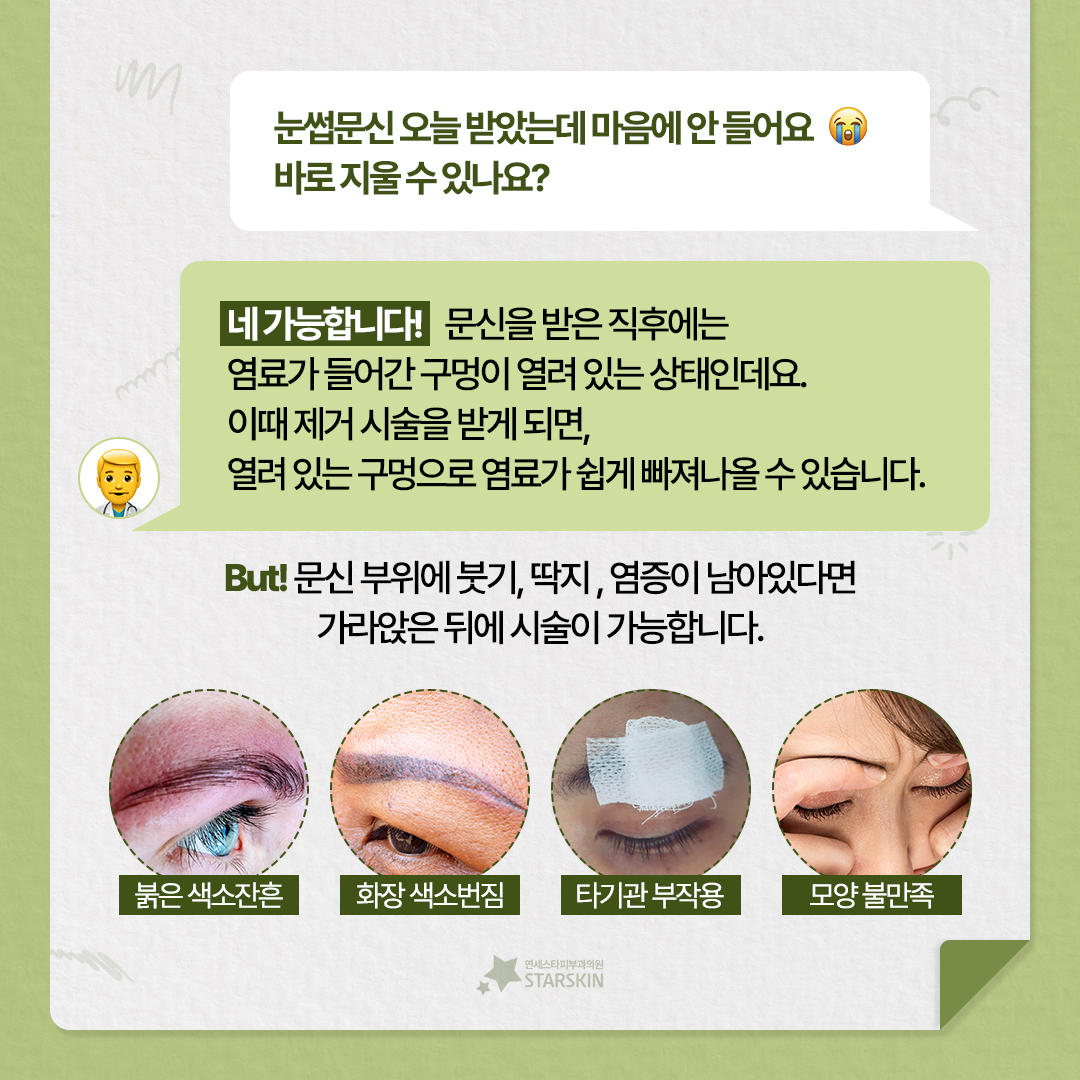
Recommended timing for eyebrow tattoo removal may vary by clinic. Generally, removal is often recommended at least 3 weeks to as long as 3 months after the initial procedure.
Immediately after receiving the tattoo, the area where the dye was injected is still open. It is sometimes believed that performing removal during this period is advantageous because the dye can exit relatively easily through the open channels. However, if there is swelling, scabs, or inflammation in the treated area, it is safer to proceed after these symptoms have subsided.
In the consultation room, many people come saying, "I want to remove it right away," but the process of checking the skin condition comes first. At Yonsei Star Dermatology Sinchon, a dermatologist examines the tattooed area and skin condition to determine whether and when to proceed with removal.
Can semi-permanent tattoos be removed in one session?
Semi-permanent makeup tattoos may require fewer removal sessions compared to general tattoos. However, contrary to appearances, they often involve multiple pigments combined and deeply penetrated into the dermal layer, making it difficult to expect satisfactory results from a single removal session.
The process of color fading occurs as the broken pigment is gradually discharged from the body through the lymphatic vessels. Therefore, it is generally done in multiple sessions at regular intervals rather than trying to finish it all at once. There may be individual differences in the degree of response.

What is the R-Zero Technique?
The R-Zero Technique performed at Yonsei Star Dermatology is designed to allow for repeated application of the procedure during a single visit. Up to 4 repetitions are possible per session, and it is reported to help achieve a relatively faster fading process when performed about 3 to 5 times at one-month intervals.
The core of the R-Zero Technique is the repeated process of breaking down pigments into fine particles and preparing the recovery environment.
The R-Zero Technique proceeds as follows:
- PicoWay Laser rapidly and finely breaks down tattoo pigments.
- PFD (Perfluorodecalin) special medication is applied to quickly clear the bubble layer that forms during the procedure.
- It is applied repeatedly 3 to 4 times in one session, minimizing damage to surrounding skin tissue.
- Sessions are spaced one month apart to align with the pigment discharge process.
The same pigment removal principle applies not only to eyebrows but also to other areas, and the appropriate approach for overall tattoo removal varies depending on the condition.
Although different from tattoos, in terms of pigment settling in the skin, procedures for clearing blemishes and epidermal pigment are sometimes considered together.
For inquiries, please contact us via eyebrow tattoo removal chat consultation

Post-Procedure Makeup and Daily Care
After the removal procedure, avoiding irritation to the treated area for a few days helps with recovery. It is better to allow time for the skin to calm down rather than engaging in strenuous activities.
- Makeup can be applied after 2-3 days, but even then, avoid the treated area as much as possible.
- Face washing and showering are possible on the day of the procedure.
- It is advisable to avoid exercise, saunas, jjimjilbangs (Korean bathhouses), and swimming for about a week.
- Smoking and alcohol can also irritate the treated area, so please refrain for about a week.

Pigment Fading Process and Precautions
Immediately after the procedure, the pigment may appear darker due to swelling. Applying a cold compress at this time can help with soothing and recovery. Over time, the pigment is discharged through the lymphatic vessels, and as skin regeneration continues, the color gradually fades.
During the recovery period, special attention should be paid to scabs and UV rays. If scabs form, avoid touching them as much as possible until they fall off. Even after the scabs have fallen off, it is good to consistently apply sunscreen to reduce pigmentation. Exposure to strong sunlight without protection can lead to pigmentation remaining during the recovery process, so care is needed.

In Summary
Eyebrow tattoo removal is less a one-time procedure and more a process of dividing sessions while observing pigment depth and skin response. Timing, session intervals, and post-procedure care all collectively influence the outcome.
If you are currently concerned about an eyebrow tattoo, the first step is to check its current color and line condition.
For inquiries, please contact us via eyebrow tattoo removal consultation

Dr. Sang-Joo Lee, Chief Director (MD, PhD, Yonsei University College of Medicine and Graduate School; Dermatology Resident, Severance Hospital; President, Korean Dermatological Association) Dr. Sang-Joo Lee's Profile First Published 2023-08-09 / Last Reviewed 2026-06-16
Since individual responses and recovery speeds may vary even for the same procedure, please confirm an accurate diagnosis and treatment plan through consultation with medical staff.