

Old scars remaining on the skin are not just simple marks; they can become a daily concern that erodes self-confidence. While wounds heal over time, scars do not disappear on their own. Therefore, the first question patients ask is always similar: "Can I start now, or should I wait longer?" To put it simply, if bleeding has stopped and the wound has entered a stable phase where new skin is forming, the sooner, the better.
There is a Golden Time for Scar Treatment
Many people overlook the fact that there is a 'golden time' for scar treatment. The older a scar is, the more firmly its tissue settles, making it more challenging to treat. Rather than waiting indefinitely for the wound to heal completely, it is reported that starting management once bleeding has stopped and new skin is filling in, during the stable phase, is beneficial for both recovery speed and results.
The sooner you respond after a scar forms, the better the results and faster the recovery. The more you delay, the longer it will take to resolve.
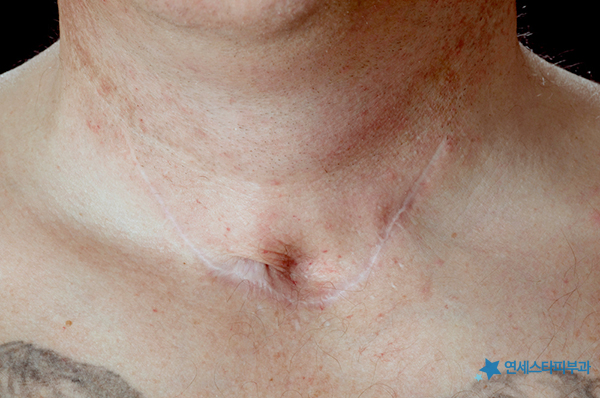
Understanding Scar Types Reveals Treatment Options
Scars do not all look the same. They vary in appearance, such as raised, depressed, or red marks, and the approach to treatment differs accordingly. The key is not to use the same laser for all scars, but to choose the appropriate method based on the scar's shape and depth.

The typical types of scars and general treatment approaches are summarized in the table below:
| Scar Appearance | Common Examples | Approach |
|---|---|---|
| Scars with red marks | Red marks after acne, early scars | Vascular laser for redness improvement |
| Depressed or thick scars | Burn scars, surgical scars | Fractional laser for inducing regeneration |
| Scars with remaining pigment | Post-procedure pigmentation | Toning lasers for pigment improvement |
When Redness Persists
For scars with persistent redness, the vascular laser Vbeam Prima is utilized. It helps reduce redness and stabilize uneven scar tissue. It is primarily used for surgical scars, red marks remaining after acne, and early scars, and it generally causes less pain and recovery burden, minimizing disruption to daily life.

For Thick and Deep Scars
For thick and deep scars, the high-output CO2 fractional laser Ultrapulse Encore is suitable. This device induces regeneration by delivering microscopic thermal stimulation deep into the skin. It is used in cases requiring active regeneration, such as old burn scars or depressed surgical scars. The treatment intensity and depth can be precisely controlled, allowing for customized treatment according to the scar condition.
If you have questions, inquire via chat about which laser is right for your scar
What is the Pinhole Technique?
The Pinhole Technique is a laser treatment that activates regeneration. It works by creating uniform micro-holes in the skin to reawaken dormant regenerative power, and recovery is relatively fast. Originally widely used for burn scar treatment, it is now broadly applied to scars caused by various factors, as well as stretch marks. A key feature is that it can be applied even to old scars. As the micro-holes heal, regeneration of surrounding tissue also occurs, meaning the stimulation reaches beyond the surface to the inside of the scar tissue, thereby helping to reactivate the skin's healing response that had long been dormant.
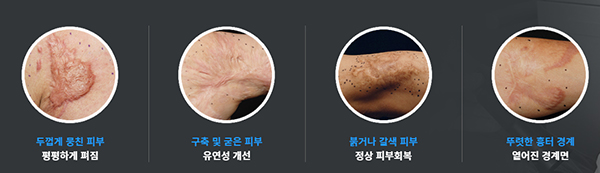
Can Old Scars Really Improve?
"My scar is over 10 years old; can it be removed?"
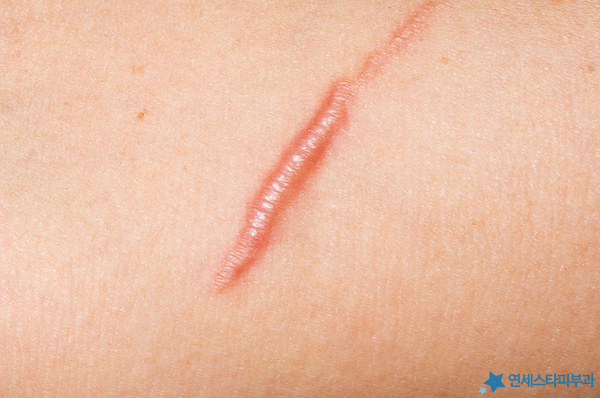
This question comes up surprisingly often in the consultation room. It also means that many people have given up on treating old scars and let time pass. To be frank, treating scars takes time, and in some cases, it can be difficult to erase them completely as if they were never there.
However, significant changes can be expected in lightening the traces to a degree that they are no longer bothersome in daily life and in smoothing out raised areas. Rather than giving up, the most important thing is to get an accurate diagnosis and choose the appropriate method for your scar. For deep and firm scars, Surgical Scar Revision may be considered in conjunction with laser treatment.
Are There Any Side Effects?
After laser scar treatment, slight redness or warmth may appear immediately, and rarely, pigmentation may occur. However, these are mostly temporary and can often be sufficiently managed during the recovery process. After the procedure, taking the following steps can aid recovery:
- Consistently maintain UV protection on the treated area
- If redness persists, adjust it further with Vbeam Prima
- If pigment remains, gradually improve it with toning lasers
- Do not arbitrarily pick off scabs or dead skin; wait for natural shedding
- Do not neglect moisturizing and calming care
Redness and pigmentation often recover with proper management, but individual responses may vary.

The Best Time for Scar Treatment is Now
Scars are difficult to disappear naturally, so the longer you delay, the more time it will take to resolve them. Rather than getting used to covering them up, if your scar has entered a stable phase, we recommend getting an accurate diagnosis and gradually starting the appropriate treatment. For certain scar types, such as depressed acne scars, the approach differs, so checking your scar condition first is the starting point.
If you wish to closely check your condition, confirm your scar condition and treatment timing via chat consultation
Chief Director Lee Sang-joo (MD, PhD, Yonsei University College of Medicine and Graduate School, completed dermatology residency at Severance Hospital, President of the Korean Dermatological Association) Chief Director Lee Sang-joo's Profile First published 2025-07-18 / Last reviewed 2026-06-16
This article is for general information purposes only, and individual differences may exist in scar patterns and recovery processes. Accurate diagnosis and treatment direction should be determined through consultation with medical professionals.