
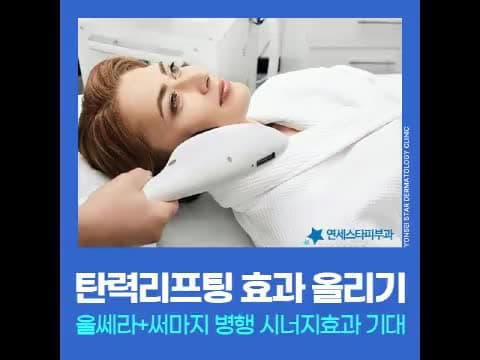
Improving Elasticity with a Divided Approach: Ulthera and Thermage
The point at which you start to feel your skin elasticity isn't what it used to be usually comes gradually after your late 20s.
Why Does Elasticity Decrease with Age?
Skin elasticity is supported by collagen and elastin in the dermal layer. However, collagen synthesis gradually decreases from the late 20s, and with added UV exposure and aging, the supporting structure of the skin gradually collapses. Changes such as blurred facial contours, sagging cheeks, and increased fine lines around the eyes and mouth mostly stem from this process.
Once elasticity begins to decline, surface management like creams or massages has its limits. An approach that stimulates the skin's internal structure itself becomes necessary.
This is why elasticity lasers targeting the dermal and fascial layers are gaining attention. In this article, we've outlined the principles of the so-called Ulthermage Combination Lifting, which uses Ulthera and Thermage together, from the perspective of skin layers.
What is Ulthermage?
Ulthermage is a term used to refer to a lifting program that combines two procedures: Ulthera and Thermage FLX. Since the two devices act on different skin layers, applying them together allows for an approach that covers a wide range, from shallow to deep layers. One device inevitably leaves some layers untouched, but using both methods separately helps reduce that gap.
Ulthera, an Ultrasound Method Targeting the Deep SMAS Layer
Ulthera uses high-intensity focused ultrasound, called HIFU, to deliver energy to the SMAS layer, approximately 4.5mm deep from the skin surface. When ultrasound converges at one point, it generates heat of about 65-70℃, which contracts the fascial layer and induces collagen and elastin regeneration. Since it tightens the supporting structure itself rather than pulling the surface, it is used for facial contouring, double chin, and cheek sagging improvement.
While some tightening may be felt immediately after the procedure, the most noticeable changes tend to appear around 2-3 months post-procedure, when collagen is remodeling. Key features are summarized as follows:
- Delivers energy to the SMAS fascia layer with high-intensity focused ultrasound
- Creates thermal coagulation points to induce tissue contraction and collagen regeneration
- Uses DeepSEE real-time ultrasound imaging to confirm target points while avoiding nerves and blood vessels
- Primarily targets contours, double chin, cheek sagging, and jawline
Thermage, a Radiofrequency Method Heating the Dermal Layer
Thermage delivers radiofrequency energy to the dermal layer, contracting collagen fibers and inducing new collagen production. While the monopolar radiofrequency heats the dermis, the middle layer of the skin, to about 65-75℃, the epidermis is protected by a cooling system. Because it stimulates the dermis broadly and uniformly without damaging the outer surface, it is used for improving skin texture, reducing fine lines, and managing pores. It is an FDA-approved device applied not only to the face but also to the eye area, neck, and body parts.
- Heats the dermal layer with radiofrequency energy to induce collagen contraction and regeneration
- Protects the epidermis with a cooling system, selectively stimulating only the dermis
- Targets fine lines, pores, skin texture, and overall elasticity
- Applicable to thin and sensitive areas like around the eyes and mouth
If you're curious about the right combination for your skin, consult via chat
What's Different When Both Procedures Are Combined?
When Ulthera and Thermage are performed individually, they are effective for their specialized layers, but some layers remain untouched by a single device. Combining the two procedures allows for an approach that addresses both shallow and deep layers, from the dermal layer to the SMAS fascia layer. The differences between the two methods, categorized by mechanism of action, suitable candidates, and features, are summarized as follows:
| Category | Ulthera | Thermage |
|---|---|---|
| Mechanism of Action | High-intensity focused ultrasound (HIFU) delivers heat to the SMAS fascia layer | Radiofrequency (RF) heats the dermal layer to induce collagen contraction and regeneration |
| Suitable Candidates | Concerns about sagging contours, double chin, cheek sagging | Concerns about skin texture, fine lines, pores, overall elasticity |
| Features | Tightens supporting structures without pulling the surface, avoids nerves and blood vessels with real-time imaging | Protects the epidermis with cooling, selectively stimulates only the dermis |
In clinical practice, even with the same equipment, results can vary depending on the practitioner's experience and skill. Ulthera's real-time imaging technology also requires the judgment of a specialist with an understanding of skin structure and anatomy to be utilized effectively.
Why Use Skin Boosters Together?
It is common to combine elasticity lasers with skin boosters. When skin nutrients are supplemented while collagen regeneration is activated by the laser, the regeneration process can proceed more smoothly and help maintain results for longer. The commonly used Gouri·Juvelook·Rejuran Skin Boosters differ in their ingredients and purposes.
- Rejuran is a regeneration injection based on salmon DNA (PDRN) components, targeting damaged tissue regeneration and elasticity recovery.
- Juvelook continuously stimulates collagen production along with improving volume.
- Gouri is a hyaluronic acid-based product used for hydration and supplementing cheek sagging, and is also used to compensate for occasional cheek hollowing after Ulthera.
Which combination is right depends on your skin condition and improvement goals, so it's best to decide through consultation.
Things to Check Before and After the Procedure
The recovery process and duration of effects can vary depending on post-procedure care. We recommend referring to the following:
- For 3 days after the procedure, it is best to avoid saunas, jjimjilbangs (Korean bathhouses), and strenuous exercise.
- For 1-2 weeks after the procedure, sunscreen and sufficient moisturizing are important.
- Refrain from alcohol and smoking for 24 hours after the procedure; cleansing and makeup are possible from the next day.
- We recommend consuming protein and vitamin C to aid collagen regeneration.
- The effects and duration may vary depending on individual skin conditions.
For elasticity management, what matters more than which device is used is whether the combination and approach are suitable for your skin condition. Ulthermage is a combination that addresses both shallow and deep layers by applying different methods to each skin layer, and combining it with skin boosters can help maintain the results. Please have a thorough consultation before the procedure to plan what's right for your skin.
If you're curious about the direction of elasticity improvement, consult now
Chief Director Lee Sang-joo · Dermatologist. The chief director of Yonsei Star Dermatology Sinchon reviewed this article. As the president of the Korean Dermatological Association in 2026 and an adjunct professor at the Department of Dermatology, Yonsei University College of Medicine, he has long been involved in skin treatments, including pigment and scars. You can find more about the medical team on the Chief Director Lee Sang-joo page.
First published 2026-06-30 / Last reviewed 2026-07-23
This article provides general information about elasticity and lifting procedures, and the appropriate method and results may vary individually depending on skin condition and degree of aging. Please confirm the suitability and combination of procedures through consultation with a dermatologist.