
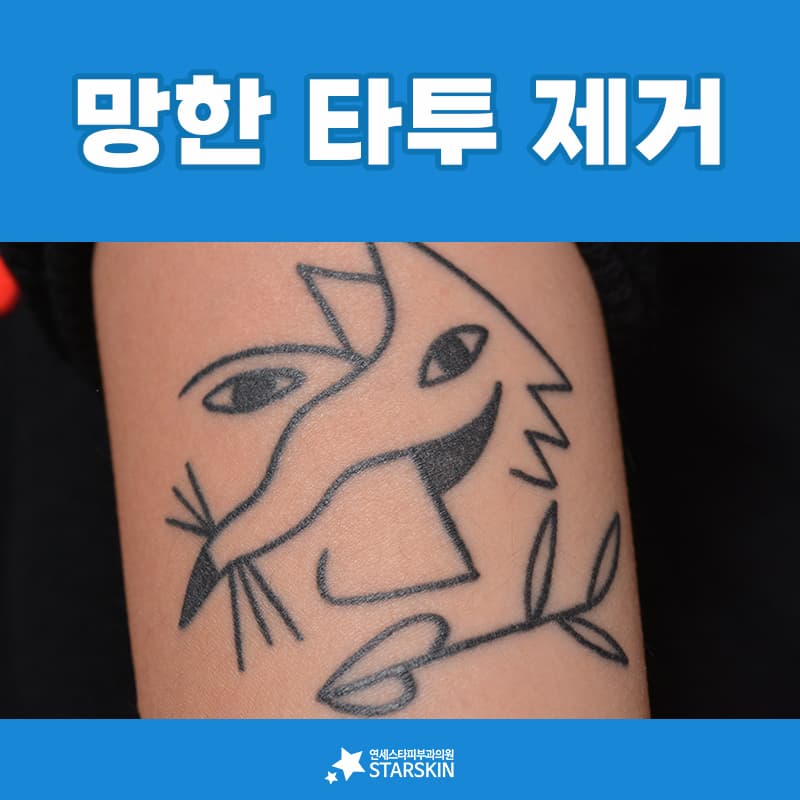
If you're upset every time you see a tattoo you don't like, it's better to remove it as soon as possible. There are several methods for tattoo removal, and we've summarized what each method can and cannot handle.
When can you start removing it?
After getting a new tattoo, the skin can become irritated, leading to scabs or blisters. You should wait until your skin heals before considering removal.
Many people believe they need to wait at least one month after getting a tattoo. However, during this time, the tattoo pigment settles into the skin, which can actually prolong the removal period.
When a tattoo is applied, small holes are created on the skin's surface to inject the pigment. If these holes close completely, the rate at which the pigment exits slows down. At Yonsei Star Dermatology Sinchon, you can receive treatment immediately after the scabs on your skin disappear. If your skin has healed within 2 weeks to 1 month after getting the tattoo, you can start then.
What each of the three methods handles
| Method | Process | Limitations |
|---|---|---|
| Self-applied creams and gels | May help lighten tattoo pigment | Limited effectiveness and concerns about side effects like skin irritation or burns |
| Tattoo removal surgery | Removes the tattooed skin by suturing | Difficult for large tattoos or in areas where the skin cannot be easily pulled |
| Laser Tattoo Removal | Destroys pigment with PicoWay Laser | Requires multiple sessions, typically 1 to 2 months apart |
Self-removal products may not be effective for all types of tattoos, and cosmetic ingredients can be harsh, requiring caution. Surgery can be considered if removal is needed in a short period.
How bubbles are handled when using a laser
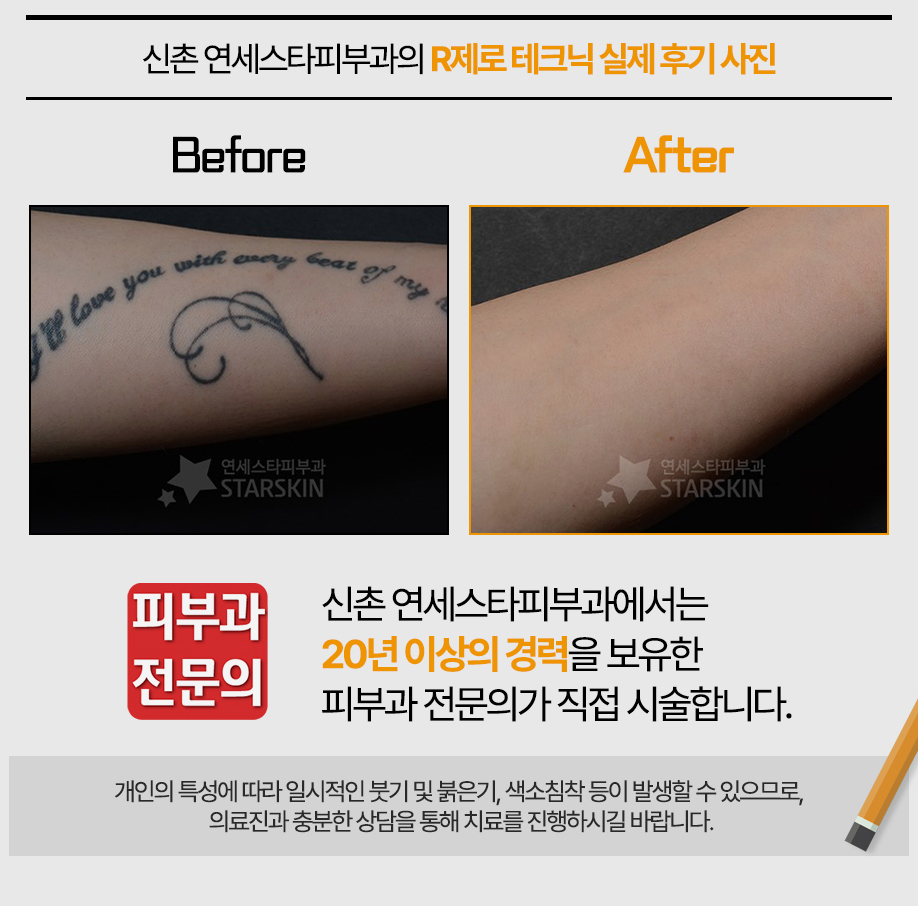
At Yonsei Star Dermatology Sinchon, we proceed with the R-Zero Pinhole Technique. In the past, a white bubble layer would rise over the treated area after the laser, obstructing repeated irradiation. We would wait 20 minutes for the bubbles to disappear before continuing.
Now, with PFD, the bubble layer can be immediately removed, allowing up to four irradiations per session without overstressing the skin.
After PicoWay Laser irradiation, you can also receive scar prevention treatment using the Pinhole Technique to create space for blisters to drain. Detailed information is available in the R-Zero Pico-Frectat Tattoo Removal guide and the Pinhole for Burn & Surgical Scar treatment guide.
Factors determining the number of sessions
Several factors influence the number of sessions.
- Tattoo size
- Amount of ink pigment
- Individual immune cell response
If it's a semi-permanent eyebrow tattoo with only faint traces remaining, it might be removed in as few as 5 sessions, while typical tattoos can take 10 or more sessions. As this is a long-term treatment, the patient's commitment can determine the outcome.
You might think that a stronger laser intensity will remove it better, but higher power can strain the skin and lead to scarring rather than pigment removal. We recommend receiving treatment at a clinic with a board-certified dermatologist.
Conditions that increase pain and methods to reduce it
Pain varies from person to person but also depends on conditions. Areas with thin skin, such as the wrist, neck, and ankle, tend to feel more pain, and larger tattoos result in a wider treatment area, leading to more pain.
Yonsei Star Dermatology Sinchon uses a low-pain system:
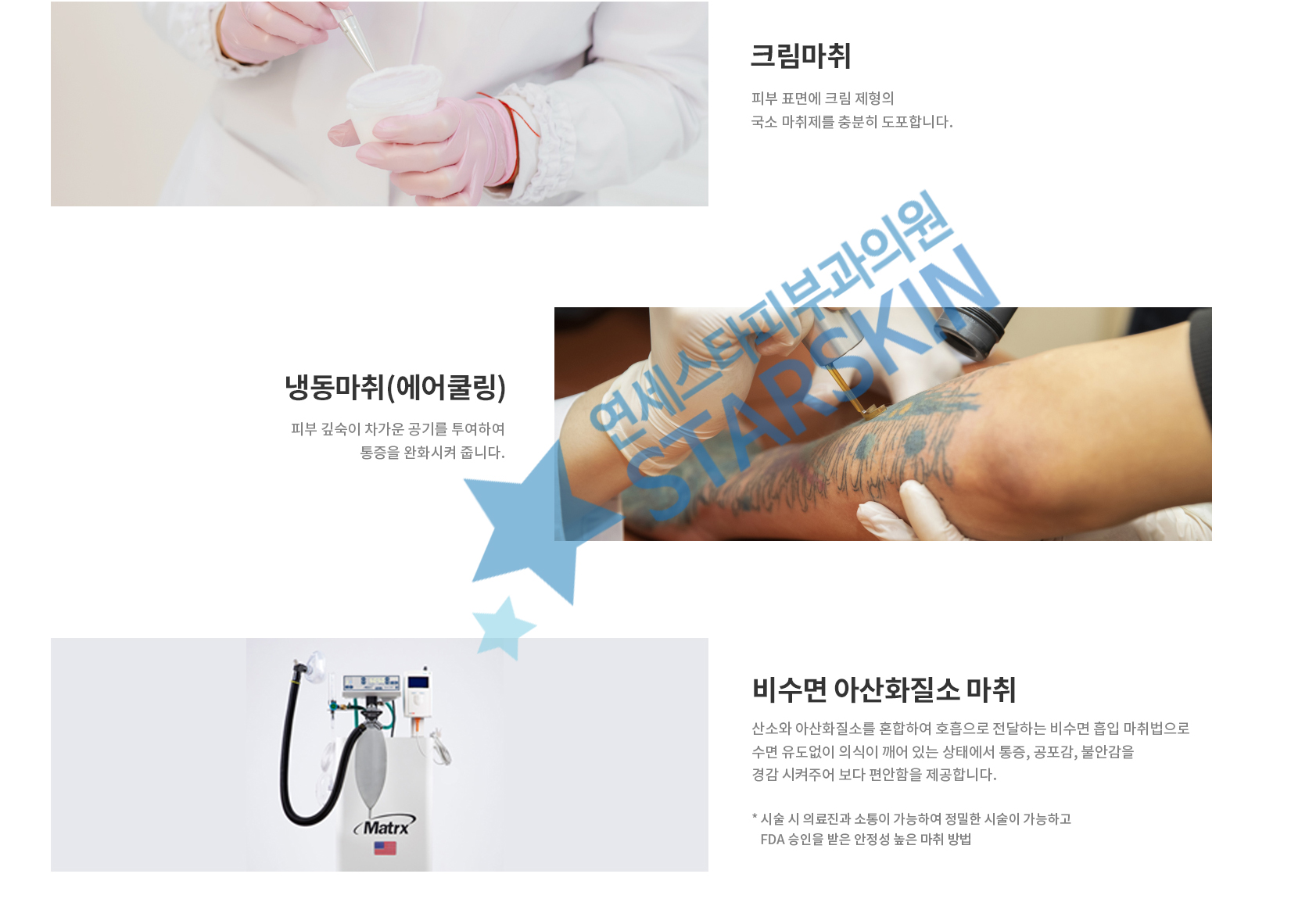
- Topical Anesthetic Cream is sufficiently applied to the skin surface for local anesthesia.
- Air cooling delivers cold air to reduce pain.
- Non-sedative nitrous oxide anesthesia reduces pain and anxiety while the patient remains conscious, without inducing sleep.
Nitrous oxide anesthesia allows communication with medical staff during the procedure and is an FDA-approved anesthesia method. It is not administered to everyone but is applied when fear of pain makes the procedure difficult to proceed.
You might think that tattoo removal would be more painful than getting a tattoo, given the higher number of sessions. The perception of pain can vary individually, and we are prepared to ensure you can receive treatment comfortably.

When choosing where to receive treatment
Yonsei Star Dermatology Sinchon has five board-certified dermatologists who personally perform removal procedures, prioritizing safety above all else.
The overall treatment flow can be seen in the Tattoo Removal Treatment Guide, and inquiries for consultation can be left via Chat Now.

Authored and Medically Reviewed by Dr. Kang Jin-moon, Chief Director (Board-Certified Dermatologist) Former Resident in Dermatology at Severance Hospital · Former Professor at Bundang CHA Hospital Member of the Korean Dermatological Association · Member of the Korean Society for Aesthetic and Dermatologic Surgery View Medical Staff Profile
First published 2023-11-23 · Last reviewed 2026-07-29
This article contains general medical information and does not substitute for individual diagnosis and treatment. Results and recovery progress may vary individually.