

Suture scars remaining on the face after surgery or an accident, even if small, often appear in highly visible areas. Can these scars truly fade with laser treatment? To answer directly, improvements in reducing visibility have been reported when the approach is tailored to the scar's color, shape, and経過期間, which is why accurate diagnosis is paramount.
Areas frequently exposed, such as the forehead, around the eyes, or mouth, can lead to psychological burden in daily life. While suture scar laser treatment is widely used nowadays, the application method varies depending on the scar's characteristics, so the same laser may not be equally suitable for everyone.
In what situations do facial suture scars remain?
The circumstances under which facial suture scars remain are broader than one might think. In the clinic, the following cases are frequently observed:
- Areas where lacerations from traumatic accidents were sutured
- Areas where tumors or cysts were removed and then sutured
- Incision sites after facial surgeries such as double eyelid surgery
- Injuries sustained in daily life, such as falls or collisions
Scars are more likely to remain distinct in areas where the wound is deep or skin tension is strong. The shape and color of the scar also vary depending on individual constitution, presence of inflammation, and suturing method.

How do lasers work on scars?
After suturing, redness, color changes, depressions, or protrusions may remain even after a certain period. Suture scar laser treatment is a representative method used in such cases.
Lasers work by improving the color of scar tissue, alleviating excessively proliferated tissue, and promoting faster skin regeneration. While positive effects on overall improvement are reported, the number and method of laser applications vary depending on the scar's depth, shape, and elapsed time. Therefore, satisfaction can be increased when a personalized plan is established and progressed while observing the course.
Even for the same suture scar, the choice of laser differs depending on whether it is in the red or white stage. Reading the color and shape first is the starting point of treatment.
If you have similar concerns, you may find it helpful to also review Characteristics and Management of Facial Surgical Scars and Scar Management After Cosmetic Surgery.
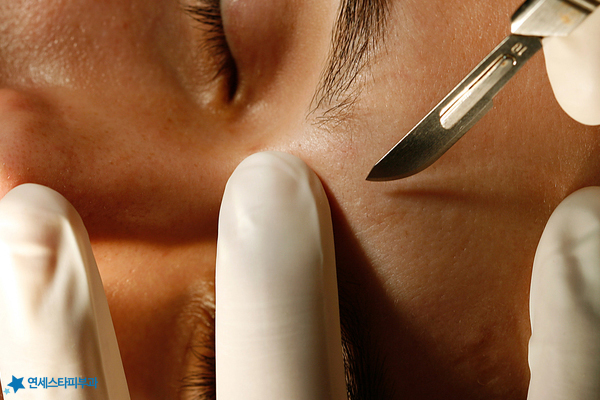
When can treatment begin?
One point to consider is when facial suture scar treatment can begin. While it is not advisable to neglect a scar until it becomes raised and white, laser treatment is applied after a certain degree of skin recovery has occurred.
Therefore, it is difficult to start immediately after surgery. It is recommended to begin treatment once bleeding has stopped, stitches have been removed, and the wound area has stabilized to some extent.
For questions, inquire via chat consultation about suture scar treatment timing
Laser selection varies by scar color
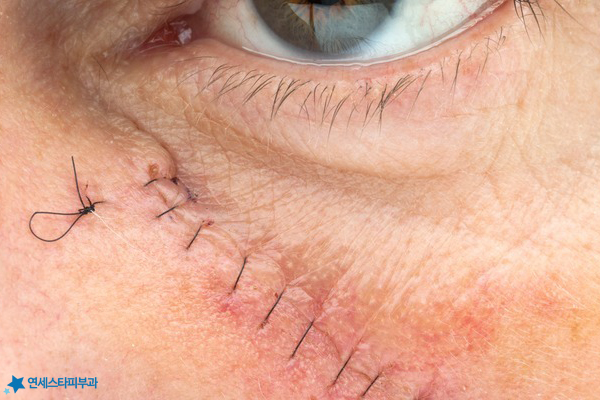
Suture scars change in color and shape over time. The approach varies depending on the stage.
| Scar Stage | Characteristics | Approach |
|---|---|---|
| Red Scar (Erythematous) | Early stage after suturing, appears red due to associated vascular dilation | Vbeam Prima laser, which selectively reacts to blood vessels, to alleviate redness |
| White Scar (Hypopigmented) | Over time, color turns white, with atrophy or depression | Ultrapulse Alpha, StarLux, etc., to promote collagen formation and soften boundaries |
Red scars are an early manifestation, and starting treatment relatively quickly at this stage can help prevent progression to larger scars, and the course is reported to be faster.
White scars or raised scars are forms where the redness has faded over time. In cases where skin tissue is atrophied or depressed, lasers that induce skin regeneration are needed. This method helps collagen formation through microscopic stimulation. For white scars, the approach is not so much about returning to completely normal skin, but rather about softening the boundaries with the surrounding skin and reducing visibility. A natural improvement effect, making the scar less noticeable in daily life, can be expected.
For raised or hardened scars, Surgical Scar Revision or Triamcinolone Scar Injection may also be considered.

Things to check before treatment
Here are items worth reviewing when considering suture scar treatment:
- Check the current color of the scar: is it in the red or white stage?
- Elapsed time since suturing and whether stitches have been removed
- Understand the scar's form: is it depressed or raised?
- Is it a frequently exposed area, or an area with strong skin tension?
- Was there a history of scars easily becoming prominent?
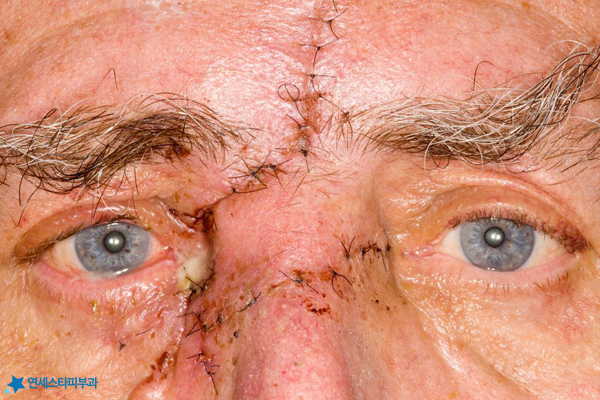
Sometimes, observation is prioritized
Suture scars can naturally fade over time. However, the extent varies from person to person depending on skin characteristics, and color changes or tissue changes may become fixed.
Therefore, it is advisable to consult with medical staff to determine whether the current condition requires treatment or if observation is prioritized. This is because the plan changes depending on the starting point and scar characteristics, even for the same area.
For questions, inquire via chat consultation about suture scar laser treatment

Sang-Joo Lee, Chief Director (MD, PhD, Yonsei University College of Medicine and Graduate School; Completed Dermatology Residency at Severance Hospital; President of the Korean Dermatological Association) Chief Director Sang-Joo Lee's Profile First published 2026-03-03 / Last reviewed 2026-06-16
Since the course and response of scars can vary from person to person, it is recommended to consult directly with medical staff to determine an accurate diagnosis and treatment timing.