
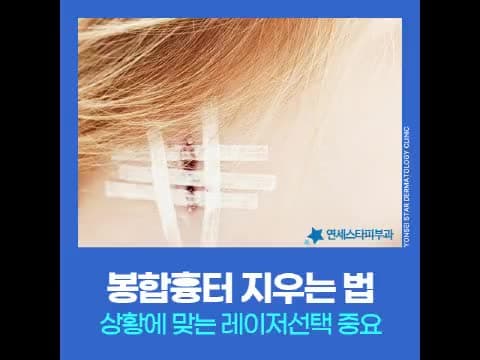
After the skin is significantly opened and sutured due to a traffic accident, fall, or surgery, it's natural to worry about how the scar will remain even after the stitches are removed.
Why Scars Can Remain Even with Good Suturing
Skin has a tendency to return to its original position, so even if the suturing itself was meticulously done, the wound may open or a scar may remain. Therefore, for surgical suture scars, while suturing and initial management are important, the degree of the scar can vary greatly depending on how it is treated afterward.
Treatment can begin within 1-2 weeks after stitch removal, and appropriate intervention at this time can help reduce the scar from becoming deeply entrenched later.
Not missing this period when redness remains is key to initial surgical scar management.
Suture Scars Are Not All One Shape
Many people only think of 'raised line scars' when they hear surgical scars, but in reality, they appear in various forms, and the appropriate treatment differs depending on the shape.
| Suture Scar Type | Characteristics |
|---|---|
| Red Scars | A state where blood vessels overproliferate and expand during the initial recovery process, appearing red |
| White Linear Scars | A form that turns white over time and stands out as a line |
| Raised Scars (Hypertrophic Scars) | A form where collagen is excessively produced, resulting in a thick, raised appearance |
| Depressed Scars (Atrophic) | A form where the skin is sunken due to damage to the dermal layer |
| Keloid Scars | A form that spreads beyond the original wound area to the surrounding skin |
Accurately identifying the type of your scar is the first step in surgical scar treatment. If it's difficult to determine which type it is, consulting with scar photos is also an option.
Red Scars: Why Early Intervention is Important
If redness remains in an early suture scar, Vbeam Prima vascular selective laser is used. The 595nm wavelength is selectively absorbed by hemoglobin in the blood vessels, working to organize excessively proliferated or expanded blood vessels. It can be used on sensitive areas like the face, and surface irritation is relatively low, allowing for a quick return to daily life.
In the clinic, we often see that early intervention in the red stage is advantageous in reducing the scar from thickening or solidifying in color later. If it's a cosmetic surgery area where red scars recur, the approach principle is similar to cosmetic surgery scar management.
Approach to White, Hardened Scars and Depressed Scars
When scars have turned white and become prominent lines over time, Ultrapulse Alpha CO₂ Fractional Laser precisely delivers energy to the dermal layer to stimulate hardened tissue and induce new collagen regeneration. It features a CoolScan™ mode to reduce discomfort during high-energy delivery and is an upgraded version of Ultrapulse Encore, known as a scar treatment laser.
If the suture scar is deeply depressed, laser treatment alone may have limitations. If fibrotic tissue beneath the scar is pulling the skin down, Subcision is performed concurrently.
- Special needles are used to cut the fibrous adhesions beneath the scar.
- The pulling force is released, creating an environment for new collagen to fill the space.
- It is performed sequentially with Ultrapulse Alpha to approach from both above and below.
In this way, the scope of treatment can be expanded with Multi-Laser Scar Treatment that combines equipment according to the type.
Managing Keloid Forms, Including Recurrence
Depending on body type or area, scars may appear as keloids, spreading larger than the original wound. Keloid suture scars require managing the possibility of recurrence, so a combined approach of laser and Triamcinolone Scar Injection is needed rather than a single treatment. Starting laser treatment early when redness remains can help suppress further scar development.
In Summary
Suture scar treatment varies depending on the shape, color, and time of occurrence. For early red scars, vascular laser may be helpful; for hardened white scars, equipment that stimulates regeneration; and for depressed forms, combining with Subcision may be beneficial. The goal is to consistently improve the scar to be as inconspicuous as possible, rather than completely eliminating it from the start. We recommend setting up a plan tailored to your scar condition through consultation.
Author · Dr. Sang-Joo Lee · Board-Certified Dermatologist Dr. Sang-Joo Lee is the chief director of Yonsei Star Dermatology Sinchon, where he has long treated pigment and scars. He will serve as the president of the Korean Dermatological Association in 2026 and as an adjunct professor at the Department of Dermatology, Yonsei University College of Medicine. For more details on his background, please refer to Medical Staff Introduction. · Last reviewed on July 23, 2026
This article provides general medical information, and treatment methods and outcomes may vary depending on the type of suture scar and individual skin condition. For specific diagnosis and treatment plans, please consult with a board-certified dermatologist.