


When red lines start appearing one by one on the abdomen and buttocks as the belly grows, one's heart often sinks. Pregnancy stretch marks are a common skin change experienced by many pregnant women, but once they set in, they rarely disappear completely on their own. As a result, more and more people are looking for management methods even during pregnancy. However, at this time, the safety of the fetus is paramount, so the principle is to focus on safe management rather than aggressive treatments like lasers. In this article, we will summarize stretch mark management that can be practiced during pregnancy, as well as the safety of laser treatments performed after childbirth, according to the color stages.

Why Pregnancy Stretch Marks Occur
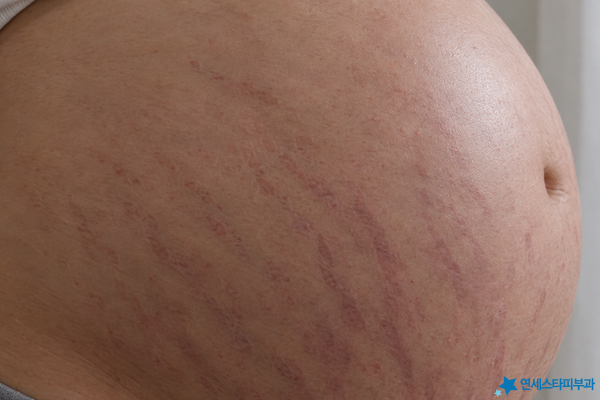
As the fetus grows and the abdomen rapidly expands, the collagen and elastin in the dermis layer cannot keep up with the speed and break, creating pregnancy stretch marks. This is not simply skin stretching, but rather damage to the dermal structure itself, so the marks often remain even after weight returns to normal post-delivery.

Weight gain is not the only cause. Hormones whose secretion increases during pregnancy are known to be involved in weakening collagen structure, so pregnancy stretch marks can appear even if there hasn't been significant weight gain. If there is a family history of easily developing stretch marks, the likelihood may be even higher.
Pregnancy Stretch Mark Management and Safety During Pregnancy
During pregnancy, it is safer to focus on daily management and prevention rather than medical procedures. The goal is to maintain skin elasticity and reduce the further development of stretch marks.
First, moisturizing. Dry skin makes collagen and elastin more prone to breaking, so it is helpful to consistently apply a gentle moisturizing cream or oil to areas prone to stretch marks, such as the abdomen, buttocks, and breasts, from early pregnancy.
Second, weight and nutrition. Rapid weight gain is a major factor that accelerates skin stretching. It is advisable to maintain an appropriate weight gain range as guided by an obstetrician and to ensure adequate intake of nutrients that aid collagen synthesis and sufficient hydration.

When is Laser Treatment Possible?
Because it is difficult to completely rule out the potential impact of laser devices on the fetus during pregnancy, pregnancy stretch mark laser treatment is, in principle, postponed until after childbirth. Even immediately after childbirth, it is generally performed after the body has recovered to some extent. If breastfeeding, it is necessary to first consult with a dermatologist about the possibility and timing of the procedure. Confirming safety first is the basic sequence of this treatment.
Pregnancy stretch marks initially appear as red lines and, over time, change into white, atrophic marks. Therefore, the most important factor in treatment is timing, and the approach varies depending on the color stage.
Laser Treatment by Color Stage
For red-stage stretch marks, Vbeam Prima vascular selective laser is applied. This method involves specific wavelengths being selectively absorbed by hemoglobin in the blood vessels, acting only on the red lesions and minimizing impact on surrounding healthy tissue. Starting early in the red stage can help reduce the progression to white marks.
For old stretch marks that have already turned white or are deeply indented, the dermal collagen is damaged, requiring a more active regenerative approach. Ultrapulse Alpha is a CO2 fractional laser, where energy delivered to the dermis layer stimulates damaged tissue to induce new collagen production. A key feature is the ability to adjust density and depth according to skin condition.
For deeply indented white stretch marks, the Pinhole Technique may be performed concurrently. This method creates multiple tiny channels in the stretch mark area with fine needles, delivering growth factors and nutritional components necessary for regeneration to the dermis layer. It is known to be more effective in smoothing the texture than laser alone. The decision to combine treatments should be made after consulting with an experienced specialist, considering the depth and extent of the stretch marks and the skin condition.
Even after laser treatment, moisturizing should continue. Since dryness can worsen stretch marks again, it is advisable to maintain a moisturizing routine before and after treatment and to also adhere to habits that avoid rapid weight changes.

Summary
The key to managing pregnancy stretch marks is to focus on safe, moisturizing-based prevention during pregnancy, and after childbirth, to approach them with laser treatment appropriate for their color and condition. Since the suitable method and number of sessions may vary depending on the extent and stage of pregnancy stretch marks and individual skin condition, we recommend consulting thoroughly with a dermatologist to create a personalized plan. If you have any questions, you can check through consultation inquiry.

Author · Dr. Lee Sang-joo / Dermatologist As the chief director of Yonsei Star Dermatology Sinchon, Dr. Lee Sang-joo provides comprehensive dermatological treatments including skin boosters, scars, and pores. Detailed credentials can be found in the Medical Team Profile. · Last reviewed September 14, 2026
This article is intended to provide general medical information, and treatment effects and downtime may vary depending on individual skin conditions. For an accurate diagnosis and treatment plan, please consult with a dermatologist.