

Self-harm scars are lasting marks on the skin, a choice made during moments of physical fatigue and emotional instability. The first question most people ask when they come for treatment is usually one: "Can this scar really fade?" To answer directly, while the treatment method varies depending on the depth and age of the scar, noticeable improvement has been reported through consistent progress.
These marks, also called self-inflicted wounds or hesitation marks, often appear on relatively visible areas like the face, wrists, or legs. The social stigma associated with them can make people hesitant to seek medical help, and during this time, the scars can become deeply entrenched.
Why is it better to treat self-harm scars as early as possible?
It is generally better to treat scars as early as possible. In the initial stages, when a scar is newly formed, it is likely to be less severe or deep. During this period, treatment with the Vbeam Prima vascular laser can help reduce redness, and relatively quick recovery can be expected.
The problem is time. After about half a year, scar tissue becomes fixed and firmly established in the skin. Due to the nature of scars, people often seek treatment after a certain amount of time has passed, which increases the difficulty of treatment.
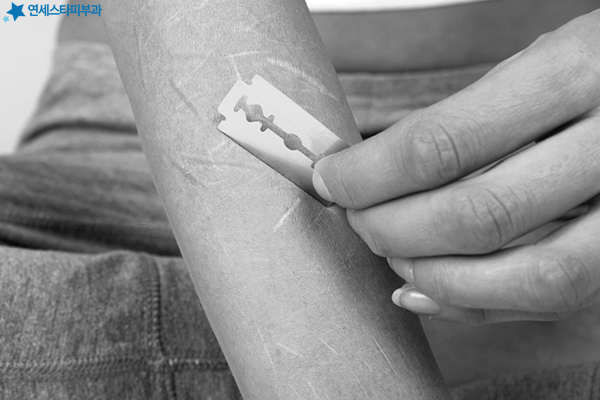
In the examination room, many individuals feel more emotionally withdrawn due to the presence of the scar itself rather than the scar's appearance. Although these marks are self-inflicted, they tend to remain in visible areas, so the starting point of recovery is ultimately linked to emotional stability.
How do old self-harm scars change over time?
Over time, depressed marks become established and turn white, making them more prominent. They can be difficult to fully conceal with long sleeves or hair, which can be a constant source of concern.
Since the approach varies depending on how the scar has formed, it helps to first categorize its condition.
| Scar Condition | Key Characteristics | Considered Approach |
|---|---|---|
| Early Scar | Redness, shallow depth | Vascular laser to reduce redness |
| Fixed Depressed Scar | Whitish discoloration, indentation | CO2 Pinhole Technique to induce regeneration |
| Keloidal Nature | Gradually protruding and enlarging | Consider combining injection treatment |
For such fixed, depressed scars, a self-harm scar laser method that sufficiently activates the skin's regenerative power is necessary. Similarly, burn scars and cosmetic surgery scars that undergo skin regeneration share the same principle.
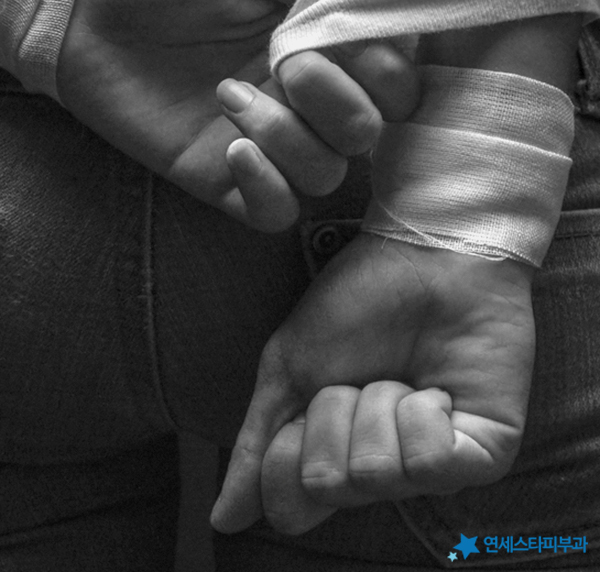
What is the principle of the CO2 laser Pinhole Technique?
For fixed scars, the CO2 laser Pinhole Technique can be considered as a self-harm scar laser method. This method uses Ultrapulse Encore to create tiny, dense holes, allowing new skin to grow in those spots to refine the scar. The principle is to promote collagen production and enhance skin regeneration.
This treatment helps to loosen deformed and clumped scar tissue during the recovery process and restore it to a state similar to normal skin. It is widely used not only for self-harm scars but also for old scars caused by various factors such as burns.
If you are curious about the detailed methods of Pinhole-type treatments, you may find it helpful to also review Mild Pinhole treatment information and Pinhole Alpha treatment information.
If you have any questions, please feel free to leave them via chat consultation regarding self-harm scar laser treatment.

Combine injection treatment for keloidal nature
If the scar has a keloidal nature, gradually protruding and increasing in size over time, we recommend combining it with injection treatment that can help reduce its height. When self-harm scar laser and Triamcinolone Scar Injection are performed together, it may help reduce the possibility of further enlargement or recurrence.
If you are curious about the characteristics of keloid scars, you can find more detailed information in Understanding the Characteristics of Keloid Scars.

How long will the treatment take?
For self-harm scars, while refining the visible marks is important, emotional stability must also accompany the process. Self-harm scar laser treatment is usually planned for around one year. However, if the scar is large and deeply entrenched, the treatment period can be quite long, possibly exceeding three years.
Here are some points to keep in mind when undergoing treatment:
- The earlier you seek treatment, the shallower the scar, and the smoother the recovery process.
- Scars that have been fixed for more than half a year require consistent treatment over multiple sessions.
- Even with good progress, repeated self-harm can negate previous efforts.
- If both depressed and keloidal characteristics are present, consider combining laser and injection treatments.
- The warm interest and support of those around you are crucial for recovery.
It is necessary to take a long-term approach and proceed steadily rather than being impatient. Even with good progress, if self-harm is repeated, all previous efforts can be wasted, which is why treatment and emotional care must go hand in hand.
Not enduring it alone is the beginning of recovery
Although it may be a difficult time, we hope you do not bear the external marks and internal pain alone. We wish you a successful recovery through warm attention and gradual treatment. Since the outcome may vary depending on the depth and area of the scar, as well as individual skin condition, it is best to determine the appropriate approach after a direct consultation with a medical professional.
If you have any questions about the treatment direction or duration, please feel free to contact us via chat consultation for self-harm scar treatment.

Chief Director Lee Sang-joo (MD, PhD, Yonsei University College of Medicine and Graduate School, completed dermatology residency at Severance Hospital, President of the Korean Dermatological Association) Chief Director Lee Sang-joo's Profile First published 2025-04-16 / Last reviewed 2026-06-16
This content is for general information purposes only, and treatment outcomes may vary individually. Please confirm an accurate diagnosis and treatment plan through consultation with medical staff.