

If brown spots suddenly become prominent on your face in the mirror, it might not be simple melasma but seborrheic keratosis. The first questions that usually come to mind are, "Why did this appear, and can I remove it with cosmetics?" To answer directly, seborrheic keratosis is a lesion where the skin surface has thickened, making improvement difficult with home care alone. Accurate diagnosis and laser treatment are necessary.

What is Seborrheic Keratosis and Why Does It Occur?
Seborrheic keratosis is one of the common pigmentary disorders that appear with age. Medically, it is also called senile lentigo or seborrheic keratosis. As the name suggests, it mainly occurs after the age of 40. As skin cells age, melanin pigment accumulates excessively in specific locations, and in that process, the epidermis thickens, forming the lesion.
Therefore, its mechanism of occurrence is fundamentally different from melasma or blemishes, which simply result from skin darkening. It's better to understand it as a problem where epidermal tissue changes along with it, rather than just a problem of pigment spreading thinly.

Appearance of Seborrheic Keratosis and Differences from Other Pigmentary Disorders
Seborrheic keratosis varies widely in color from brown to black, and its surface is often rough or slightly raised.

Because it often involves a 'raised sensation' and 'changes in skin surface texture,' it clearly differs from simple pigmentary disorders that spread flat. Even if they look like similar brown spots, their texture is different.
It is also common for melasma or blemishes to be mixed in. This is why it is easy to confuse it with the seemingly similar Epidermal Pigment Removal area. In the clinic, it is not uncommon for patients to think they have melasma when it is actually seborrheic keratosis, or vice versa.
Below is a simple summary of the differences in the table.
| Category | Seborrheic Keratosis | Melasma·Blemishes |
|---|---|---|
| Mechanism | Epidermal thickening + pigment accumulation | Primarily epidermal pigmentation |
| Surface Texture | Rough or raised | Generally flat |
| Main Age Group | After 40s | Relatively broad age range |
| Home Care Response | Almost none | Partial change possible |
Why is Improvement Difficult with Cosmetics?
Many people try to manage seborrheic keratosis with whitening cosmetics or exfoliants. However, seborrheic keratosis is a lesion where the skin epidermis is thickened and raised, so improvement is difficult with cosmetics that merely lighten epidermal pigment.

On the contrary, improper use of strong exfoliants can cause skin irritation or inflammation, making the lesion more noticeable.

It is reported that early and accurate diagnosis of seborrheic keratosis, followed by professional laser treatment, is safer.
Rather than self-diagnosing and irritating the skin, it is important to first confirm whether it is a pigmentary lesion or another skin problem. Differentiation from Laser Lesion Removal targets that appear similarly raised may be necessary, so it is better not to conclude with self-diagnosis alone.
You can easily ask any questions you have through chat consultation regarding differentiation of seborrheic keratosis and pigmentary disorders.

How does RePott Laser work for Seborrheic Keratosis Removal?
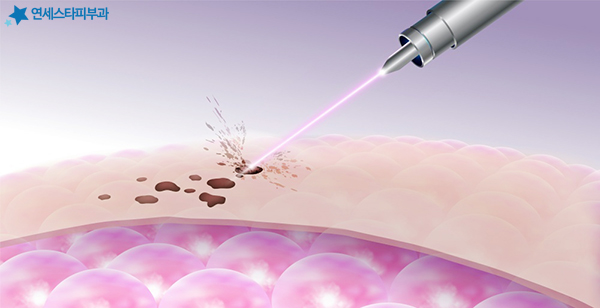
One of the representative devices used for seborrheic keratosis treatment is the RePott Laser. The RePott Laser is characterized by its design to precisely target melanin pigment using wavelengths that react to pigmentary lesions, while minimizing damage to surrounding healthy skin.
It is also considered an advantage that it can show changes in epidermal pigment problems like lentigo or seborrheic keratosis with relatively few sessions. However, as explained earlier, seborrheic keratosis has the characteristic of being thick and raised, so depending on the thickness, an additional process of refining the skin surface may be necessary.

In such cases, a combined procedure with other lasers in addition to RePott may be performed, and since its synergy is reported to be more positive than single-laser treatment, it is worth considering. When dealing with pigments of various thicknesses and distributions, a plan may be established in conjunction with an epidermal pigment removal approach.

What to Take Care of After the Procedure
While RePott Laser is a laser used for seborrheic keratosis, post-procedure care determines the results. Here are the key points to remember during the recovery period:
- Scab management: Do not forcibly remove small scabs that form after laser treatment; let them fall off naturally. If you have applied a regenerative patch like DuoDERM, it is best not to touch it until it is removed by the clinic.
- UV protection: After the procedure, the skin becomes sensitive and pigmentation may occur, so it is essential to apply sunscreen thoroughly.
- Skin regeneration: Consistent use of moisturizers and regenerative creams can help with skin recovery.
- Customized plan: The number of procedures may vary depending on skin condition and lesion depth, so consult with a dermatologist to create a plan.
Adhering to these four points can ensure a more stable recovery process.
Will It Never Reappear Once Removed?
Once removed, most seborrheic keratoses disappear, but new ones may appear in other areas as you age. Therefore, to reduce recurrence, basic practices such as daily UV protection, skin care, and regular check-ups are important. Rather than concluding that it can be completely prevented, a realistic perspective is to reduce its frequency through management.

In Summary
Seborrheic keratosis is not just a cosmetic issue but also related to skin aging, so accurate diagnosis and treatment are key. Since home care has clear limitations, we recommend safely approaching it with professional procedures like Reepot Laser for seborrheic keratosis removal. However, please remember that individual results may vary.
If you have questions about treatment direction or recovery process, 💬 Chat with us now


Chief Director Lee Sang-joo (MD, PhD, Yonsei University College of Medicine and Graduate School, Completed Dermatology Residency at Severance Hospital, President of the Korean Dermatological Association) Chief Director Lee Sang-joo's Profile First Published 2025-08-28 / Last Reviewed 2026-06-16 This content is for general information purposes only, and individual symptoms and treatment responses may vary. Accurate diagnosis must be confirmed through face-to-face consultation with medical staff.