
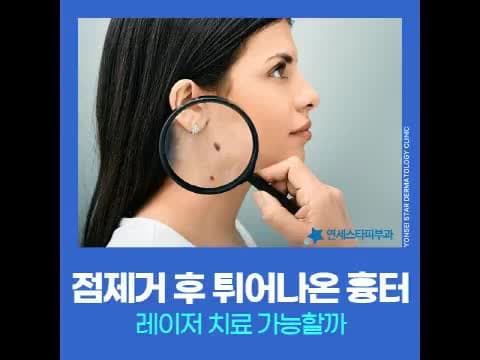
If months after removing a mole, the mark hasn't subsided but has instead risen and hardened, it's natural to worry whether it's okay to leave it as is.
Reasons Why Scars Remain After Mole Removal
After laser mole removal, the skin typically regenerates over several months, naturally becoming similar to the surrounding healthy skin. However, if the mole was large, or if skin tissue damage occurred during the procedure, sufficient regeneration may not occur even after 6 months, or conversely, excessive regeneration can lead to mole removal scars.
Mole removal scars are broadly divided into two types. In this article, we explain how to approach the raised type. Mole removal itself is performed via Laser Lesion Removal, and any subsequent scarring requires a separate approach.
Why Do Raised Mole Removal Scars Occur?
Raised mole removal scars occur when dermal tissue is damaged, leading to abnormal collagen arrangement and excessive proliferation. Initially, they appear red, gradually turning white over time, and tend to become more prominent if left untreated.
It's important to remember that mole removal scars are difficult to disappear naturally, and the longer they are left untreated, the more challenging treatment can become.
It's not uncommon for people to only recognize a scar years after mole removal, rather than immediately, and seek treatment belatedly.
The Core of Treatment: Two Approaches
Treatment for raised mole removal scars involves two main axes:
- Reducing excessively proliferated collagen to lower the scar's height.
- Precisely removing raised tissue with lasers and inducing skin regeneration.
If the scar has hardened and risen, a combination of Triamcinolone Scar Injection to induce the breakdown of excessively proliferated collagen and reduce its height, followed by laser treatment, can be helpful. Applying both approaches together can yield more balanced results than a single treatment.
| Approach | Role |
|---|---|
| Medication Injection | Induces breakdown of excessively proliferated collagen, reduces height |
| Laser (StarLux, Ultrapulse Alpha, etc.) | Precisely stimulates raised tissue, activates skin regeneration |
This combination of devices and injections, known as Multi-Laser Scar Treatment, is used to help raised scar tissue naturally resemble the surrounding healthy skin.
Precision is More Important Than Equipment
What we emphasize in the consultation room is that the outcome depends not on the equipment itself, but on how precisely the scar condition is approached. Even with the same laser, results can vary depending on the energy settings and the practitioner's experience. Therefore, it's crucial to consult thoroughly with a dermatologist experienced in scar treatment and develop a plan. If there's a tendency for Keloid Scar to spread beyond the original wound area, recurrence management must also be considered.
If you have any questions, we recommend checking your scar condition through a consultation first.
Even Old Scars Don't Have to Be Given Up On
Some people may have given up on mole removal scars that formed a long time ago. While older scars tend to have harder tissue, requiring more treatment sessions and longer durations, treatment is not impossible. By stimulating a regenerative response externally with lasers, even old tissue can show gradual improvement. However, consistent treatment without arbitrary interruption is necessary.
In Summary
Mole removal scars, whether depressed or raised, are difficult to disappear completely naturally. Raised mole removal scars, in particular, can become more prominent if left untreated. Therefore, even if they formed a long time ago, we recommend consulting for a plan tailored to your scar.
Author · Chief Director Lee Sang-joo / Dermatologist As the Chief Director of Yonsei Star Dermatology Sinchon, he has long treated everything from moles and pigmentation to scars. He serves as the President of the Korean Dermatological Association in 2026 and an adjunct professor at the Department of Dermatology, Yonsei University College of Medicine. Detailed credentials can be found in his Medical Team Profile. · Last reviewed on July 23, 2026
This article is intended for general medical information and the treatment methods and results may vary depending on the type of mole removal scar and individual skin condition. For an accurate diagnosis and treatment plan, please consult with a dermatologist.