
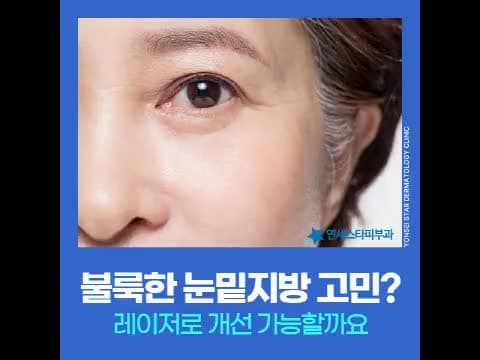
Addressing Under-Eye Fat Concerns Without Incision: Laser Under-Eye Fat Repositioning
If your under-eyes are bulging or you have a double shadow where the bottom is sunken and the top is convex, it might not just be due to fatigue.
As you age, the skin elasticity around your eyes decreases, and the fat tissue that protects your eyes pushes forward, initiating these changes. If this fat is unevenly distributed, it can look like dark circles or feel like deep wrinkles. Many people delay making a decision due to the burden of surgical methods. In this article, we've summarized how laser under-eye fat repositioning works without incision and what changes you can expect.
Why Does Under-Eye Fat Push Forward?
Fat tissue that protects the eyes is naturally present around the eyes. When you are young, skin elasticity holds this fat in place, keeping the surface smooth. However, as aging progresses or skin elasticity declines, this fat pushes forward, causing a convex protrusion.
Especially when fat is unevenly distributed, a double shadow phenomenon occurs where the upper part appears convex and the lower part appears sunken. The visible manifestations are as follows:
| Under-Eye Change | Visible Manifestation |
|---|---|
| Fat pushed forward | Under-eye appears to bulge |
| Fat unevenly distributed | Double shadow with convex top and sunken bottom |
| Combination of hollowness and fine wrinkles | Dark and tired impression like dark circles |
If your under-eyes look swollen even after getting enough sleep, you might consider structural changes rather than just fatigue.
These changes are often prominent in people in their 40s and 50s, but recently, more people in their 20s and 30s are also concerned about under-eye fat. This is because it can appear at a relatively early age due to genetic factors or lifestyle habits.
How Does Laser Under-Eye Fat Repositioning Work?
Laser under-eye fat repositioning is a method that uses laser energy to address under-eye fat without incision or surgery. After attaching a patch containing special ingredients under the eyes, shockwave energy is delivered with a laser, stimulating deep into the skin. This shockwave provides subtle stimulation to the tissue, helping to gently loosen clumped fat and guiding displaced fat to be evenly rearranged.
This stimulation can help with collagen regeneration, and activating microcirculation within the skin can positively affect waste removal and blood circulation. The characteristic of this method is that it induces subtle changes in the tissue through mechanical stimulation, rather than simply applying heat to the skin surface.
As a non-surgical method, it is performed without incision and is known for a relatively quick return to daily life after the procedure. However, the number of treatments or management methods may vary depending on the individual's condition, so it is important to plan based on a specialist's opinion.
If You Have These Under-Eye Concerns
- If your under-eyes are bulging and the area below is sunken
- If your under-eyes look swollen and tired even after getting enough sleep
- If you are concerned about dark circles and fine wrinkles together
- If you are hesitant about surgical methods and prefer a non-surgical approach
- If you want to return to daily life quickly after the procedure
If your under-eye concerns overlap with the above items, it is important to examine your under-eye structure and skin condition together before self-diagnosing. As it is a thin and sensitive area, it is safer to accurately confirm the condition before deciding on a direction.
Consult via chat if you are curious about your under-eye condition
Why Simply Reducing Fat Is Not the Answer
The under-eye area is very thin and sensitive. When people come to the clinic with under-eye concerns, many wish to only reduce fat, but approaching it by simply reducing fat can actually make hollowness more prominent or emphasize fine wrinkles. The laser-based repositioning method aims not to simply remove fat, but to allow skin elasticity to fill the area where the fat has been tidied. As a result, it is gaining attention for its potential to create a more natural and smooth under-eye line.
However, laser under-eye fat repositioning is a procedure performed at a medical institution with a board-certified dermatologist. A diagnosis of the under-eye structure and skin condition must precede the procedure, and based on this, the appropriate direction is determined.
Factors Affecting Results and Expectations
As with all procedures, results can vary depending on individual skin condition, the degree of under-eye fat, skin thickness, and other factors. This means that even the same procedure can yield different responses in different people. Therefore, it is important to thoroughly assess the current under-eye condition during the pre-procedure consultation. If you are considering the procedure, we recommend consulting with a specialist to first determine the direction that is right for you.
Under-Eye Concerns: Consultation First, Rather Than Enduring Alone
Under-eye concerns significantly impact one's impression, and many people experience stress because of them. If you are afraid of surgical methods, consulting with a board-certified dermatologist to explore non-surgical approaches is one option. The important thing is to accurately understand your under-eye structure and find the direction that suits you.
This article was reviewed by Dr. Lee Sang-joo (board-certified dermatologist), Chief Director of Yonsei Star Dermatology Sinchon. Dr. Lee Sang-joo serves as the President of the Korean Dermatological Association in 2026 and as an adjunct professor at the Department of Dermatology, Yonsei University College of Medicine. His profile can be found at Dr. Lee Sang-joo's Introduction.
First published 2026. 6. 5. / Last reviewed 2026-07-23
This article provides general information related to under-eye fat, and the appropriate method and results may vary individually depending on under-eye structure and skin condition. As it is a thin and sensitive area, please confirm the suitability of the procedure through a consultation with a board-certified dermatologist.