

We often hear stories of people suffering for a long time from burns caused by hot oil splashes or accidents during cosmetic laser procedures. The reason these stories don't feel like they're happening to someone else is that such accidents can happen to any of us. Immediately after suffering a burn, everyone's first question converges into one: "Will this leave a scar?"
To get straight to the point, whether a scar remains depends on how deeply the skin was damaged. It is reported that deep second-degree burns or worse, which damage deep into the dermis, can leave scars even after recovery.
Burn Depth Determines Scarring
The key is the extent of skin damage. The stage of a burn is classified by the degree of damage, and deep second-degree burns or worse, which damage deep into the dermis, can leave scars even after recovery. Unlike superficial burns that remain in the epidermis, when the dermis is injured, the skin's ability to return to its original state on its own weakens.
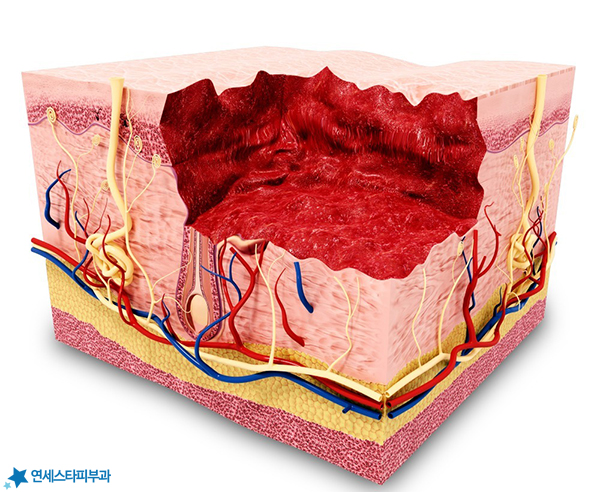
Whether a scar develops is more critically determined by how much the dermis is damaged, rather than the location or area of the burn.
Is It a Sign to Hasten Treatment?
There are signs you can use to gauge whether you need to start treatment early after a burn. However, the items below are for reference only, and an accurate diagnosis requires a direct examination in the clinic.
- Blisters and oozing develop, accompanied by swelling
- The peeled area of the blister has a transparent, pinkish hue
- Severe pain is felt in the damaged area
- Conversely, if nerves are damaged, pain may feel weaker
It is difficult to determine the depth of a burn solely by the intensity of pain. Rather than being relieved by less pain, it is safer to observe blisters, oozing, and changes in color together.

Why Are Established Scars a Concern?
Deep second-degree burn scars become more prominent due to differences in color, texture, and thickness compared to normal skin. If they are located in areas difficult to cover with clothing, such as the hands or face, the psychological stress can be considerable.
In the past, there was a perception that scars once established on the skin were difficult to erase and had to be lived with for life. Now, laser treatment can achieve a significantly satisfactory level of improvement. If you have similar concerns, it may be helpful to review Characteristics and Treatment Directions for Burn Scars.

Laser Selection Varies by Situation
Even for the same burn scar, the approach differs depending on when it was formed and its current condition.
| Scar Condition | Applicable Laser | Direction of Action |
|---|---|---|
| Early, not yet raised white | Vbeam Prima (Vascular Laser) | Redness is managed, changes relatively quickly |
| Old, established scar | Ultrapulse Encore + Pinhole Technique | Activates skin regeneration through micro-holes |
If treatment begins early, when the scar has not yet turned white and raised, applying a vascular laser like Vbeam Prima to manage redness can show relatively quick changes. Conversely, for older, established scars, a combination of Ultrapulse Encore and the Pinhole Technique is suitable.
The Pinhole Technique works by creating microscopic holes in the problematic lesion with a laser to activate skin regeneration. It can be applied regardless of skin thickness and also helps improve pigmentation. If you are curious about the Pinhole method, you can refer to Mild Pinhole Treatment Principle or Pinhole Alpha Treatment.
If you are new to burn scar treatment and feel overwhelmed, you can start by organizing your current condition through Chat Consultation for Burn Scar Laser Selection.

Reasons for Difficult Treatment
Treating deep second-degree burn scars is quite challenging. The shape of the lesion and the condition of the skin vary from person to person. To increase treatment satisfaction, it is necessary to carefully plan the selection and intensity of laser devices, as well as the treatment cycle. In some cases, multiple devices and treatment methods may be combined to enhance effectiveness.
Since treatment must be carried out by appropriately configuring the situation and methods, careful consideration is needed when choosing a clinic. In cases of deep scars or contractures, Surgical Scar Revision may also be considered.
Home Care to Maintain at Home
During treatment, frequent laser exposure can quickly dry out the skin and weaken its protective barrier against external stimuli. Carefully following the items below can create synergy with laser treatment.
- Apply prescribed ointment as directed
- Maintain the skin barrier sufficiently with moisturizing cream
- Diligently apply sunscreen to reduce pigmentation stimulation
- Do not arbitrarily remove scabs or dead skin cells
- If you notice changes, consult with medical staff instead of making your own judgment
Persistence Over Impatience
Deep second-degree burn scars are not a problem that can be dramatically resolved in a short period. It is important to approach treatment with patience and consistently work towards gradual improvement. The extent and speed of change can vary from person to person, so we recommend taking a long-term view rather than being impatient with one or two results.
If you find it difficult to determine the stage of your scar and which laser is right for you, try Chat Consultation for Current Scar Condition first.

Even burn scars that were once thought to be lifelong can be significantly improved by progressively selecting lasers appropriate for their condition.
Dr. Lee Sang-Joo, Chief Director (MD, PhD, Yonsei University College of Medicine and Graduate School; Dermatology Resident, Severance Hospital; President, Korean Society for Dermatology) Dr. Lee Sang-Joo's Profile First Published 2025-04-10 / Last Reviewed 2026-06-16
This article provides general information only. The appearance of burn scars and treatment responses may vary individually, and accurate diagnosis and treatment direction should be determined through consultation with medical staff.