

Hello, this is Yonsei Star Dermatology Sinchon.
Sometimes, difficult moments leave traces on the body. Self-harm scars on the wrists, arms, or neck may not fade over time, inevitably causing concern in daily life. The first question patients ask in the consultation room is simple: "Can these marks really get better?" To answer directly, it's difficult to make them disappear completely as if they never happened, but significant improvement, to the extent that they are not easily noticeable in daily life, can certainly be expected.
Why we recommend treatment over covering up
Many people who are bothered by scars wear long sleeves even on hot days, or try to cover them with makeup or tattoos. While this is an understandable choice, there are limitations to the scope and duration of what can be covered.
Cover-up tattoos, in particular, require caution. It is known that once pigment settles in the skin, subsequent scar treatment itself becomes more complicated. This is why we recommend addressing the scar itself from the beginning, even if it takes a little longer.

Who seeks treatment for scars?
The age range of people who visit the hospital for self-harm scars on their wrists and other areas is surprisingly young. In the consultation room, a significant portion are teenagers.
Various pressures, such as academic stress during adolescence, conflicts with close people like friends or family, and vague anxieties, often lead to self-harm. Therefore, dealing with scars is not just a skin problem, but also involves understanding the person's life stage and situation.
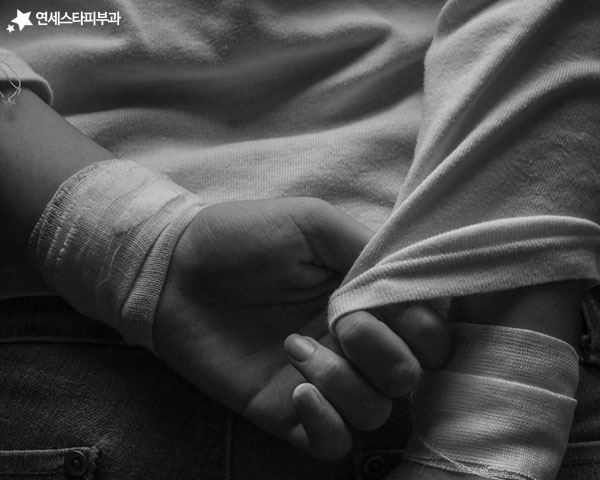
How much improvement can be expected?
The most common question we hear is, "How much can it improve?" Some people come expecting the marks to disappear completely with treatment.
Realistically, it is difficult to erase the marks as if they never existed. However, you can expect improvement to the point where they are not easily noticeable in daily life, reducing the burden on social activities. Please keep in mind that there may be individual differences in the degree of improvement.

The 6-month standard, what about old scars?
Old marks can also be treated with laser therapy. However, when determining the treatment direction, we consider the time when the scar occurred, usually setting 6 months as a turning point.
- Within 6 months: The wound is less settled, so treatment is relatively faster and easier.
- After 6 months: The marks often turn white, making them more noticeable.
- Scars older than 1 year and scars older than 10 years: From a treatment perspective, the patterns are similar, so the method does not change significantly.
- Old scars: It's good to keep in mind that it may take longer than initial treatment.
In other words, treatment is not impossible if you miss the timing. However, the earlier you start, the smoother the process tends to be.

How does the Pinhole Technique treat scars?
Hospitals often use lasers to treat self-harm scars. Among them, the Pinhole Technique, which uses a CO2 laser like Ultrapulse Encore, creates tiny, dense holes in the skin. Laser energy is delivered through these channels, boosting the skin's own regenerative power.
The Pinhole Technique is less about aggressively shaving off scar tissue and more about inducing the skin to regenerate itself.
Visible skin scars can thus be helped to recover to a less noticeable state through laser treatment. If you want to know more about how Pinhole-type treatments proceed, reviewing Mild Pinhole and Pinhole Alpha can help you understand.
If you are wondering which method is right for your scar, you can use Pinhole Technique Scar Treatment Chat Consultation.

Mental healing that must accompany skin treatment
It is reported that many people with self-harm scars, also known as hesitation marks, also experience depression. Because they have a strong tendency to be alone, self-harm sometimes recurs even during treatment.
Therefore, scar treatment does not end with skin procedures alone. When mental and psychological care are provided together, the results of scar treatment can be stably maintained. Depending on the depth and type of the scar, approaches such as Surgical Scar Revision may also be considered.

Things to remember before starting treatment
Scar treatment is a long process that takes quite a bit of time. Knowing the following in advance can help you prepare mentally.
- Even for mild cases, it's generally good to view it with a timeframe of about 1-2 years.
- If the wound is deep and the scar is severe, it may take longer.
- Even with good treatment progress, if self-harm recurs, all previous efforts can be undone.
- For teenagers, the careful cooperation of parents and family is a great help in recovery.
It's important to understand that this treatment values consistency more than haste.
If you are curious about scar types or treatment duration, you can easily ask through Scar Treatment Chat Consultation.

With a renewed mindset
Today, we looked at the Pinhole Technique as a helpful method for treating self-harm scars. Since the type of scar and recovery patterns vary from person to person, even similar-looking marks, like Surgical Scar, require different approaches depending on the cause and condition.
We hope that if there is anyone around you who needs help, or if you have marks left from a momentary decision in the past, you can start treatment with a new mindset and return to a healthy and comfortable daily life.

Chief Director Lee Sang-joo (MD, PhD, Yonsei University College of Medicine and Graduate School, completed dermatology residency at Severance Hospital, President of the Korean Dermatological Association) Chief Director Lee Sang-joo's Profile First Published 2025-01-16 / Last Reviewed 2026-06-16
This content is for general information purposes only, and since scar conditions and recovery patterns vary individually, please consult with medical staff for an accurate diagnosis and treatment plan.