

As the season for lighter clothing approaches, stretch marks that have been hidden begin to become noticeable. We often receive the question, "Can I still improve them if I start now?" To answer directly, the treatment approach for stretch marks varies depending on their stage of progression, and results are reported to be better when treatment begins early.
Why do stretch marks occur, and are they a type of scar?
Stretch marks can appear anywhere on the body. They are a type of scar that occurs when collagen fibers in the dermis are destroyed due to weight gain, pregnancy, rapid growth, or excessive hormone intake. When the skin stretches rapidly in a short period, the dermal layer cannot withstand the change and subtly tears, leaving stripe-like marks on the surface.

In other words, stretch marks are not just a simple skin problem but a structural change in the dermal layer, which is why fundamental improvement is difficult with moisturizers alone.
What's the difference between red stretch marks and white stretch marks?
Stretch marks change in appearance over time. Initially, they are red, but over time, they gradually turn white and fade in color. These two stages differ in treatment difficulty and approach.

| Category | Stage of Progression | Characteristics | Treatment Direction |
|---|---|---|---|
| Red Stretch Marks | Early | Redness due to vascular dilation, active | Reported to show good results with early treatment |
| White Stretch Marks | Late | Faded color, fixed as scars | Difficult to treat, multiple treatments recommended |
Stretch marks, a difficult-to-treat skin condition, generally show the best results when treated during the red stretch marks stage. For white stretch marks, improvement is not easy, and we often recommend at least 5 or more treatments.
Stretch marks are reported to show better results the earlier they are treated. The optimal time for treatment is when redness remains.
In the clinic, many people give up, thinking it's too late
In the clinic, we often see people hesitating to treat, saying, "It's already turned white, so it's too late." It is true that old white stretch marks require more effort than red stretch marks. However, even old stretch marks can improve more than their current state with consistent treatment, and the extent of change may vary individually.

Yonsei Star Dermatology Sinchon provides customized stretch mark treatment tailored to the type, progression, and location of stretch marks to enhance treatment efficacy. We approach treatment by reducing side effects such as pigmentation and pain through extensive treatment know-how, and by maximizing skin regeneration using specialized medications.
How do conventional methods differ from laser treatment?
Conventional stretch mark treatments using vitamin A derivatives have shown a low improvement rate of about 10%, and side effects such as scarring can occur, leading many people to give up on treatment.

Yonsei Star Dermatology's customized stretch mark treatment has reported an improvement rate of about 93% and is highly satisfying as a treatment method that reduces concerns about scarring or pigmentation. However, results and recovery patterns may vary individually.
For questions, inquire via chat consultation regarding stretch mark types and treatment timing
What lasers are used for red stretch marks and white stretch marks, respectively?
Stretch marks cannot all be resolved with a single device. The red stage and white scar stage are approached with lasers that have different operating principles.
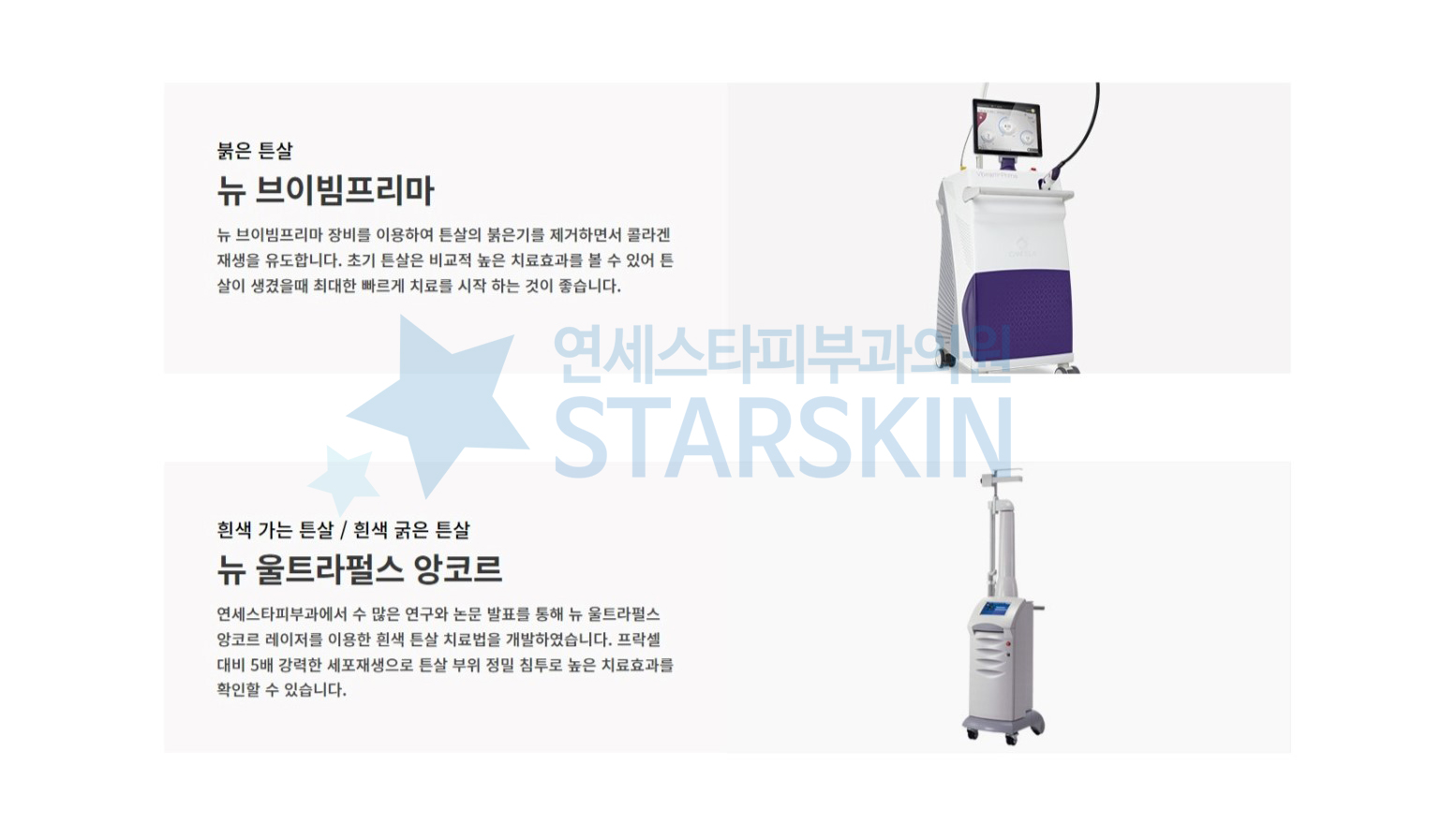
- For red stretch marks, the latest Vbeam laser, Vbeam Prima, is used to reduce redness and induce collagen regeneration.
- In the process of managing redness, a delay in the progression to white stretch marks can also be expected.
- For white stretch marks, the Ultrapulse Encore laser, known for its stronger skin cell regeneration than fractional lasers, is utilized.
- The treatment is precisely infiltrated only into the stretch mark area to minimize irritation to the surrounding healthy skin.

Before and After Treatment, Please Remember These Points
Stretch mark laser treatment often involves a staged approach rather than a single session, depending on the extent of progression. Reviewing the following points before starting can be helpful:
- If redness remains, do not delay and consult as early as possible.
- For white stretch marks, plan your schedule assuming multiple treatments rather than a single session.
- Understand in advance that temporary swelling, redness, scabs, and exfoliation may occur after treatment.
- Pay attention to UV protection and avoid irritation in the treated area.
- Confirm the type and progression of your stretch marks with the medical staff.

Stretch marks are no longer an untreatable skin condition, and there is potential for improvement with timely treatment. However, the appropriate laser varies depending on the color and progression of the stretch marks, so establishing a plan tailored to your condition is the first step.
💬 Consult NowRepresentative Director Lee Sang-joo (MD, PhD, Yonsei University College of Medicine and Graduate School, Completed Dermatology Residency at Severance Hospital, President of the Korean Dermatological Association) Representative Director Lee Sang-joo's Profile First Published 2022-03-23 / Last Reviewed 2026-06-16
This article provides general information to aid understanding of stretch marks, and treatment effects and recovery patterns may vary individually. For an accurate diagnosis and treatment plan, please consult with medical staff.