

Self-harm scars refer to marks left on the skin from self-inflicted wounds with a sharp object. "How long will it take to erase these marks with a laser?" This is often the first question people ask when they visit the clinic. To answer directly, it's more accurate to view it as a process of gradual fading through multiple treatments at approximately two-month intervals, rather than disappearing all at once in a short period.
Self-harm acts are often repetitive rather than temporary, and the marks left behind can be deeper than we might imagine. Scars on the skin are inherently difficult to change noticeably in a single session, and marks from repeated self-harm are particularly challenging to treat.
Why are self-harm scars more difficult to treat than general scars?
These scars often appear as multiple, irregularly arranged linear marks because they are self-inflicted. They are not clean, single-line scars, but rather a collection of lines of varying lengths and depths.
For such multi-branched linear scars, improving the marks by blurring them with a laser often leads to more satisfactory results than individually suturing each area. This is also why many people who are concerned about recovery time after surgery or the burden of additional scars explore laser treatment first.

How to remove self-harm scars with laser, the principle of Pinhole Technique
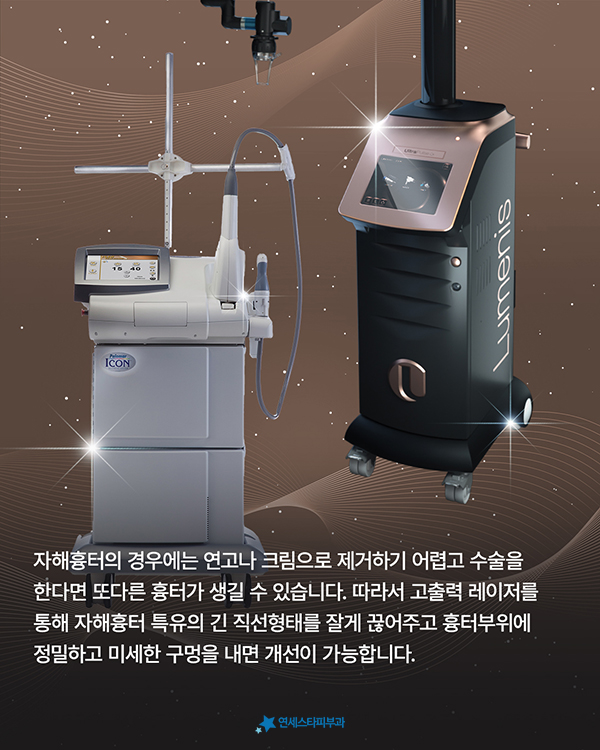
Laser treatment for self-harm scars involves creating microscopic holes in the skin around the treatment area with high-power lasers such as Ultrapulse Alpha and StarLux. Our skin has a natural tendency to heal itself when injured, and these devices help to boost that regenerative power.
This method is one of the scar treatments called Pinhole Technique. As strong skin regeneration occurs, the long, straight lines characteristic of self-harm scars gradually blur and the marks lighten. Even within the Pinhole Technique family, options vary depending on skin condition and scar depth, from less irritating methods like Mild Pinhole to Pinhole Alpha.
The Pinhole Technique is known to cause relatively less bleeding and pain, making it suitable for scar treatment that requires multiple repetitions, as it helps reduce the burden of the process.

How long does the treatment take?
This is the most frequently asked question regarding duration. Typically, it involves 5 or more sessions at approximately two-month intervals, with the detailed treatment plan adjusted based on the healing progress. The number of sessions may vary individually depending on the depth and extent of the scar and the skin's response.
It's also important to remember that if new self-harm scars appear during treatment, the entire process may need to be restarted. Therefore, regaining psychological stability alongside scar treatment becomes a crucial factor in determining the treatment duration.
In the consultation room, we often find that "the ability to see it through" rather than the duration itself determines the outcome. The following points summarize what's good to know before starting treatment:
- Understand that it's not a one-time treatment but a process of multiple repetitions at two-month intervals.
- Manage psychological stability to prevent new wounds from appearing during treatment.
- Recovery speed and scar response can vary individually, so check the progress with the medical staff.
- Be aware that temporary phenomena like pigmentation changes may occur.
For questions, inquire via chat consultation about self-harm scar laser treatment duration

What to know when you feel like giving up
Scars on the body are a topic where rapid changes are difficult to see in the short term. Repeating the same process can lead to questions like "When will this end?" and a strong desire to stop if progress doesn't meet expectations.
While some time is needed to boost the skin's regenerative power, it is reported that with repeated treatments, the marks naturally fade, and positive changes can gradually be expected. Ultimately, it can be concluded that those who see it through to the end often report high satisfaction with the improvement.
Why you don't need to panic about pigmentation during treatment
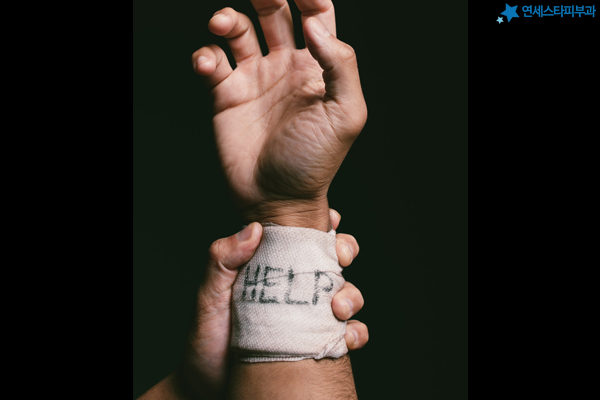
Some people are surprised when pigmentation remains around self-harm scars, making the marks temporarily appear even more noticeable. This is mostly a phenomenon that occurs during the treatment process, and in many cases, it naturally returns to normal over time. If you endure this period and continue to the end, it can lead to good results.
To improve dull pigmentation, lasers such as PicoWay may be used in combination, and considering Epidermal Pigment Removal treatment together can also be helpful during the recovery process.
However, there are complex possibilities, such as the appearance of Keloid Scars depending on skin type. To establish a treatment direction that considers such possibilities, it is paramount to receive an accurate diagnosis from a clinic where a dermatologist specializes in skin conditions. Even if it's a linear scar, it differs from a Surgical Scar, so understanding the nature of the mark first is necessary.

It's better to start treatment than to hide them
Hiding them with clothes or makeup inevitably has its limits. We hope you can start accurate treatment with a more relaxed mind and achieve good results in fading self-harm scars. Even if facing the marks feels burdensome, just taking the first step can change the direction.
If you are curious about treatment eligibility or the right method for your scars, feel free to inquire below.
💬 Chat for a consultation now
Sang-Joo Lee, Chief Director (MD, PhD, Yonsei University College of Medicine & Graduate School, Completed Dermatology Residency at Severance Hospital, President of the Korean Dermatological Association) Chief Director Sang-Joo Lee's Profile First published 2026-03-10 / Last reviewed 2026-06-16
This content is for general information purposes only; treatment responses and recovery patterns may vary for each individual. Accurate diagnosis and treatment plans should be determined through consultation with medical professionals.