

Why do facial wounds become scars?
The face is always exposed, making it susceptible to damage in daily life, from minor abrasions to wounds requiring surgery. The mark bothers you every time you look in the mirror, and the first question people ask when they visit the clinic for a scar wound is whether it's okay to leave it as is.
To put it simply, shallow wounds heal on their own, but deep wounds that are difficult to regenerate are likely to lead to scars. Therefore, instead of leaving it to natural healing, it is necessary to observe whether the skin is regenerating properly.
Even small wounds can become facial scars

Facial scars are formed through a surprisingly diverse range of paths. Abrasions, lesion removal procedures, complex plastic surgeries, and even seemingly minor injuries like fingernail scratches or pet scratches often lead to scars.
Especially since it's a highly visible area, it's best not to take even small wounds lightly. We recommend checking your condition if any of the following apply:
- If the area around the wound remains red for a long time
- If the mark gradually hardens or rises
- If the skin heals in a deeply depressed form
- If the color or shape does not normalize over time
For small wounds, observation comes before neglect. The fate of a scar is often determined by the care it receives during healing.
Initial stage with redness

In the early stages of scar formation, the shape may not be very prominent, but redness often appears intensely around the wound. This redness is due to the skin excessively creating blood vessels for rapid recovery and regeneration.

While rapid recovery is welcome, if regeneration occurs more than necessary, it can create an environment where scars are more likely to form. Therefore, at this stage, it is necessary to appropriately reduce excessive vascular proliferation.
Vbeam Prima, known as a vascular laser, helps alleviate the expansion and proliferation of blood vessels, calming skin redness and preventing the condition from worsening. It can be understood as a process that helps the skin return to a relatively clear state in the initial red stage. For similar principles in managing redness, you can also refer to Facial Redness Management Information.
Mature scars, treatment varies by shape

Over time, once a scar is fully established, its color changes to white, and it may appear either raised or deeply depressed. Even with the same scar, if the shape differs, the treatment approach will also differ.
| Scar Type | Characteristics | Treatment Approach |
|---|---|---|
| Depressed Scar | Indented shape due to tissue deficiency | Induce new skin growth with Ultrapulse Encore laser |
| Raised Scar | Prominently protruding shape compared to surrounding skin | Apply laser and Triamcinolone Scar Injection together to match height |
| Red Scar | Redness remaining due to vascular proliferation | Alleviate redness with vascular laser |
For depressed scars requiring powerful regeneration, Ultrapulse Encore laser can help new skin grow quickly. Conversely, for raised scars, laser treatment and Triamcinolone Scar Injection are applied together to match the height with the surrounding skin. Designing treatment according to the condition can help increase satisfaction. Exploring Triamcinolone Scar Injection for raised scars or Surgical Scar Revision for deep scars can broaden your options.
For questions, inquire via chat consultation about facial scar treatment
Realistic goals of treatment

More than other areas, there is a strong desire for facial scars to be treated cleanly without any marks. However, it is realistically difficult to completely restore the skin to its original state as if nothing had happened.
Laser scar treatment focuses on making the skin as similar as possible to the surrounding healthy skin. Aiming for improvement that is not easily noticeable in daily life is a more realistic approach. If you have similar concerns, Cosmetic Surgery Scar Improvement Information or Surgical Scar Management can also be helpful.
Reasons not to delay scar treatment
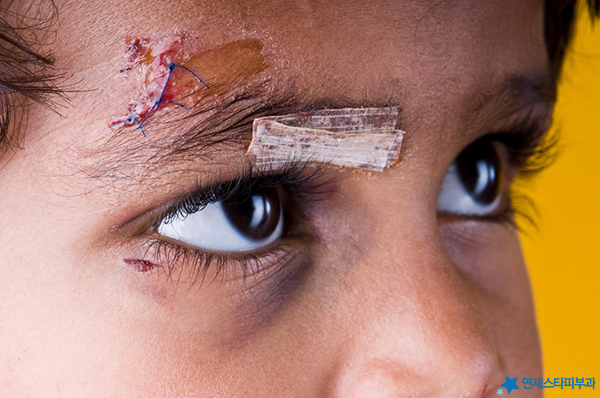
Scars on the face can change one's impression or demeanor, and sometimes lead to a decrease in self-confidence or withdrawal in social interactions. If the psychological stress becomes too great, it can affect daily life.
In the clinic, many people are eager to start treatment quickly, but in such cases, carefully checking the condition and then deciding on a direction is often more beneficial for the outcome.
Things to check before treatment

Before deciding on scar treatment, it is necessary to review various aspects through sufficient consultation. Checking the following items can help with your decision:
- Whether laser treatment can be customized according to the scar condition
- Whether the treatment process has a stable systemic structure
- Whether the medical staff has sufficient experience to produce natural results
- Whether post-treatment care and progress checks are continued
Since treatment effects and recovery speed can vary individually, we recommend making a careful decision after sufficient consultation rather than deciding at once.
💬 Consult Now
Chief Director Lee Sang-joo (Yonsei University College of Medicine · Graduate School, Doctor of Medicine, completed dermatology residency at Severance Hospital, President of the Korean Dermatological Association) Chief Director Lee Sang-joo's Profile First published 2025-04-25 / Last reviewed 2026-06-16
This article provides general information about scar treatment, and symptoms and recovery patterns may vary from person to person. Please consult with medical staff for an accurate diagnosis and treatment.