

If you have scars around your ears after a facelift
If skin sagging is severe and sufficient satisfaction is difficult to achieve with lifting lasers, some may consider facelift surgery, which involves incising around the ears to pull and fix the sagging skin and muscles. While this method offers relatively clear lifting effects, it comes with considerations such as recovery time and incision marks.
The most common question is simple: "Can the scars left on the incision line be lightened again?" To answer directly, improvement can be expected with a combination of laser and injection treatments, depending on the degree and color of the scar. However, the effectiveness and recovery patterns may vary from person to person.

Why do facelift scars occur?
While facelifts can achieve significant visible changes, the high probability of scars remaining at the incision site is a drawback. In fact, an increasing number of people are visiting dermatology clinics to lighten marks left after a facelift.
Scars tend to be larger as the pulling force, or tension, increases. Since a facelift is a surgery that artificially pulls up the skin, tension is inevitably high, which increases the likelihood of scarring. Among those concerned about facelift scars, it is not uncommon for them to be constitutionally prone to scarring.
Scars are more likely to be prominent in areas with high tension, and those with a keloid constitution require more meticulous care.
These causes of scarring and constitutional factors are similarly explained in Causes of Surgical Scars and Characteristics of Keloid Scars.
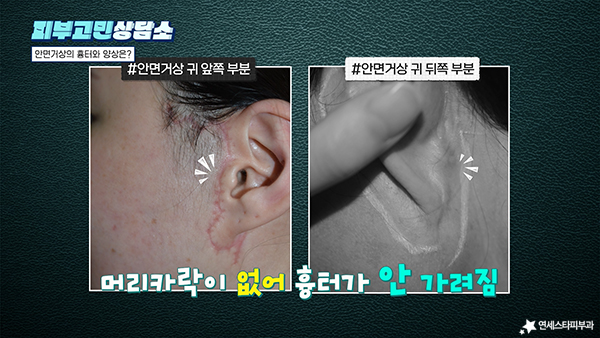

Where do marks remain and what kind?
Facelifts leave incision marks starting from the front of the ear and extending around the ear. After surgery, a red line like a band may appear around the ear, and depending on one's constitution, this area may swell and turn white over time, leaving a noticeable scar.
The degree to which it can be concealed varies by area.
| Area | Degree of Exposure | Possibility of Concealment |
|---|---|---|
| Front of ear | Skin is relatively exposed | Difficult to conceal |
| Behind ear | Inside the hairline | Can be concealed with hair |
The area behind the ear can be hidden with hair, but the front part is directly exposed, making it difficult to conceal.

How many laser treatments are typically needed?
Many people are hesitant about surgical methods due to the possibility of creating new scars. If you have similar symptoms to those described above, you can expect good changes with laser treatment, so please keep this in mind.
One of the most frequently asked questions is about the number of treatments. Like other laser treatments, it is rare for scars to disappear with just one or two treatments. The number of sessions varies depending on the degree and color of the scar; if it is not severe, about 5 sessions may be needed, while more prominent scars may require 10 or more treatments.
In the clinic, even for the same facelift scar, the approach differs depending on whether it has a reddish tint or has hardened to white. We examine both the color and thickness, sometimes combining Surgical Scar Revision or Triamcinolone Scar Injection with laser treatment.
For any questions, you can easily check through chat consultation for facelift scar treatment.
Manage your scars to prevent them from worsening
While it's important to respond well when a problem arises, it's equally crucial to prevent it beforehand and manage it to avoid further spread. If you are prone to scarring, like those with a keloid constitution, and problems are anticipated after surgery, it is advisable to start treatment as early as possible with a combined injection and laser approach.

Please consider the following during the process of recovering the surgical site without strain:
- Pay attention to posture and facial expressions to avoid excessive tension on the surgical site.
- Regularly apply ointment or use tape to relieve tension.
- Thoroughly disinfect to maintain cleanliness of the damaged skin.
- Do not neglect inflammatory signs; seek medical attention.
- Do not forget to take antibiotics if necessary.
If the wound area is improperly managed when the skin is severely damaged, inflammation can occur, and in severe cases, this can lead to larger facelift scars. Maintaining cleanliness until full recovery is paramount.

Earlier scar treatment is more advantageous
Marks from a facelift can be seen as a branch of Cosmetic Surgery Scar Treatment, and the earlier you address them before they harden, the wider your management options. We recommend exploring the possibilities of change so you don't stress over lingering marks.
If you have any further questions, detailed confirmation is available through consultation.
💬 Consult Now
Representative Director Lee Sang-joo (MD, PhD, Yonsei University College of Medicine and Graduate School, completed dermatology residency at Severance Hospital, President of the Korean Dermatological Association) Representative Director Lee Sang-joo's Profile First published 2025-04-30 / Last reviewed 2026-06-16
Since the appearance and recovery speed of scars vary from person to person, accurate diagnosis and treatment direction must be determined through consultation with medical staff.