

Eyelid surgeries like double eyelid surgery or canthoplasty have become common choices, but it's not uncommon for a long mark or a prominent red scar to remain in the incision area. When surgical marks are visible, the first question that usually comes to mind is: Will laser treatment be enough, or do I need revision surgery?
To put it simply, the appropriate method depends on the shape and condition of the scar. The two methods are not superior or inferior to each other, but rather different options used in different situations.
Why do scars form after double eyelid incision?
Eyelid surgery is broadly divided into incision and non-incision methods. However, depending on the degree of eyelid ptosis or skin condition, an incision method may be necessary, and in such cases, it is difficult to completely rule out the possibility of a scar remaining along the incision line.
During the healing process, collagen rearranges in the incision area, and if this process does not proceed smoothly, the line may become darker or the surface may become uneven. If you are constitutionally prone to scars thickening or turning red, the manifestation may be more pronounced.

Can ointments or Vaseline make scars disappear?
After surgery, antibiotic ointments or Vaseline are often applied to prevent the wound area from drying out. While such moisturizing care can protect the scar to some extent from worsening, it is difficult to consider it a method for removing already formed scars.
Once a scar has formed, it is difficult to reverse it with moisturizing alone; improvement can be expected by approaching it with systematic treatment tailored to its condition.
In the clinic, we often see cases where patients rely solely on ointment, miss the treatment window, and only seek help after the scar has hardened.
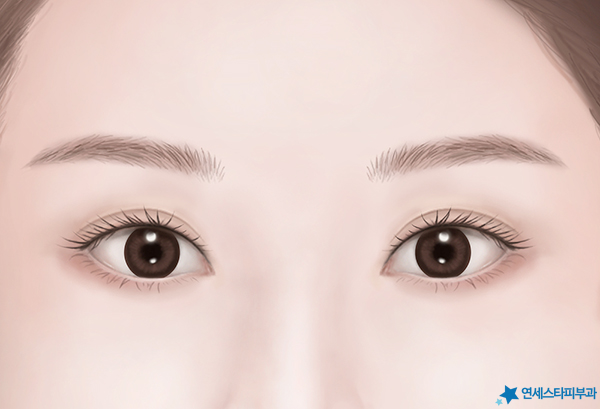
Laser vs. Revision Surgery: What's the Difference?
The methods for treating double eyelid incision scars are broadly divided into laser treatment and surgical correction. In some cases, revision surgery may be more suitable depending on the scar's condition, so it's difficult to definitively say that one is always better than the other. The differences between the two methods are summarized in the table below:
| Category | Laser Treatment | Surgical Correction |
|---|---|---|
| Suitable situations | Darkened lines, shallow depressions, accompanying redness | Deep scars or significant structural deformation |
| Additional incision | None | New incision required |
| Recovery burden | Relatively light | Recovery period required for revision surgery |
| Constitution prone to scarring | Can be considered first | Careful judgment required |
If the burden of another surgery is significant, or if you are afraid of new scars forming, or if you are constitutionally prone to scarring, it may be more reasonable to consider laser treatment first.
If you are curious about the general approach to scars, it may be helpful to also look at Cosmetic Surgery Scar Treatment Directions.

Laser Approach Varies by Scar Shape
Double eyelid incision scars also vary in shape. The treatment direction changes depending on the shape.
- If the double eyelid line is parallel and darkened, laser treatment can induce skin regeneration to lighten the line.
- If a certain part is depressed and uneven, the treatment aims to improve the sunken shape.
- For keloid-like manifestations that turn red or thicken, laser treatment can calm the redness, combined with injection procedures.
- If the color appears unusually dark, a whitening approach such as Epidermal Pigment Removal can be used.
If a thick scar tissue appears in a certain area, localized laser or injections can be applied to manage it. Triamcinolone Scar Injection, often combined when keloid-like manifestations are prominent, may also be considered depending on the condition.
When can treatment begin?
The timing for starting laser treatment is generally after the initial recovery period following double eyelid surgery and after the stitches have been removed. While you may want to start as soon as possible due to concerns about the scar, treatment is difficult while stitches remain in the treated area.
Until then, it is advisable to focus on recovering your condition without overexertion, and to pay attention to moisturizing and wound care to prevent the skin from drying out.
If you find it difficult to determine which treatment is suitable for your double eyelid incision scar, please inquire via chat consultation regarding double eyelid incision scars.

What to observe during post-laser treatment care
The area around the eyes tends to recover quickly, so the progress of double eyelid incision scar laser treatment is relatively smooth. However, as it is a thin skin area, care must be taken to avoid irritation. Here are some points to keep in mind during the recovery period:
- Fine dead skin cells may appear for about 4-5 days after treatment, but do not forcibly remove them.
- Avoid irritating the eye area by rubbing or scratching.
- Continuously apply moisturizer to prevent dryness.
- Use sunscreen when going out to reduce pigmentation.
- If the progress feels different from usual, consult a doctor instead of self-diagnosing.

To recover without scar worries
Having decided on surgery for a better appearance, scars remaining around the eyes can be disheartening. This is especially true because the face is a difficult area to conceal. By accurately examining the shape of the scar and combining laser, injections, and if necessary, surgical methods tailored to the condition, improvement can be expected. As individual results may vary, finding the right approach for your scar is paramount.
If you are curious about the method suitable for your scar, check with a consultation now.


Sang-Joo Lee, Chief Director (MD, PhD, Yonsei University College of Medicine and Graduate School, Completed Dermatology Residency at Severance Hospital, President of the Korean Society for Dermatology) Chief Director Sang-Joo Lee's Profile First published 2025-06-11 / Last reviewed 2026-06-16
This article contains general information, and since scar patterns and progress can vary from person to person, please consult with medical staff to determine the exact diagnosis and treatment direction.