
![Can Tattoo Removal Be Done in One Session? Smart Ways to Reduce the Number of Tattoo Removal Sessions | [Yonsei Star Dermatology Sinchon]](/_next/image?url=https%3A%2F%2Fagqdgbuateknhwpocrgu.supabase.co%2Fstorage%2Fv1%2Fobject%2Fpublic%2Fassets%2Fyonsei-star%2Fblog%2F224367896782%2F1.jpg&w=3840&q=75)

When researching tattoo removal, you may have come across reviews like these: "I received treatment, but it doesn't seem to be effective," "The color seems to have gotten darker," or "I've had it many times, but there's no noticeable change." Such reviews can naturally lead to vague concerns.
Today, we will explain why unsatisfactory results may occur after the first tattoo removal session and outline methods that can help reduce the total number of treatment sessions.
Can It Be Completely Erased in One Session?
Q1. Can tattoos be completely removed in one session? To answer directly, in most cases, complete removal in a single session is difficult to expect. When a tattoo is applied, the ink penetrates various layers of the skin. The laser breaks down the ink from the upper layers into tiny fragments, and the body's immune cells absorb and expel these remnants. Only after this process is complete can the deeper layers of pigment be accessed, naturally requiring multiple sessions.
Especially for tattoos with a large amount of ink, such as lettering or color tattoos, or when the pigment has penetrated deep into the dermis, it is often difficult to feel a noticeable change after just the first tattoo removal session. In other words, the reason for the many tattoo removal sessions is not due to insufficient laser performance, but because time is needed for the pigment to be gradually broken down layer by layer and expelled from the body.

Why the Color Appears Darker After Treatment
Q2. Why does the color appear darker after treatment? Some people feel that the color has become darker after their first tattoo removal session. This is not an abnormal reaction. During the process where the laser breaks down the ink particles in the upper layer, the pigment in that layer may temporarily gather closer to the skin surface, creating the effect of appearing darker. This can be a sign that the treatment is progressing normally, and with continued sessions, the pigment will gradually lighten.
If you feel the color is getting darker, it is not recommended to stop treatment or suddenly increase the laser intensity. Always consult with a medical professional to adjust your next treatment plan.

Will Increasing the Intensity Erase It Faster?
Q3. Won't increasing the laser intensity erase it faster? Laser intensity and tattoo removal speed are not simply proportional. While excessively weak output compared to the appropriate intensity will result in insufficient effect, conversely, if the intensity is increased excessively, pigment particles can be explosively destroyed, potentially damaging surrounding healthy skin tissue. Excessive laser output can increase the risk of side effects such as scarring and hyperpigmentation. Those prone to scarring need to be especially careful. It is important to receive treatment safely with appropriate intensity, even if it takes a little longer.
One of the biggest concerns with tattoo removal lasers is the long treatment period, which typically takes at least one year, and sometimes over three years. The R-Zero Technique is a method that can help reduce this period without excessively increasing laser intensity.
R-Zero Technique to Reduce Treatment Duration
When a conventional laser is applied, white bubbles appear on the skin surface, which then obstruct further laser penetration. Repeated irradiation in this state can cause significant skin damage, so it is generally common to allow a recovery period after one application.
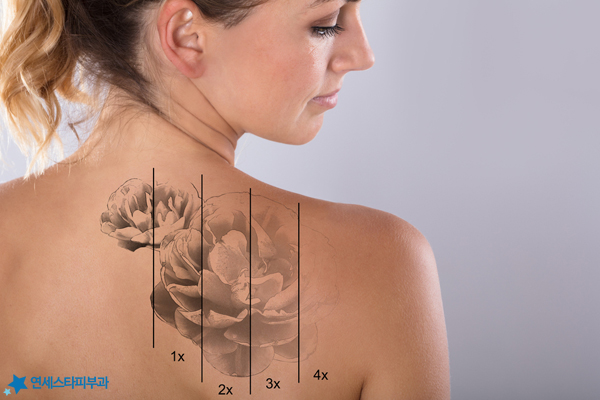
The R-Zero Technique involves applying a special medication immediately after PicoWay Laser irradiation to quickly remove these bubbles. Once the bubbles disappear, the laser penetration path is re-established, allowing for additional irradiation within the same session. By repeating this process, up to four laser applications are possible in one session.
The number of R-Zero applications is determined by the medical staff based on the individual's skin condition and tattoo characteristics. Please consult with a medical professional before making a decision.
The Difference Equipment Makes
Equipment selection also plays an important role in reducing the number of tattoo removal sessions. The PicoWay Laser uses ultra-short pulse energy in picosecond (one trillionth of a second) units to break down ink particles into much smaller units than traditional nanosecond lasers.
When pigment is broken down more finely, it becomes easier for the body's immune cells to absorb and expel it. If the efficiency of pigment expulsion within the treatment interval increases, it becomes possible to effectively access deeper layers of pigment in subsequent treatments. Furthermore, with various wavelengths such as 532nm, 730nm, 758nm, and 1064nm, it can be customized for color tattoos by color, allowing for much safer expected results. This meticulous approach minimizes thermal damage to surrounding skin tissue, leading to relatively faster recovery and reduced burden on the body even after a single tattoo removal session.
Thus, the combination of the R-Zero Technique and the PicoWay Laser is an approach that can help reduce the total number and duration of tattoo removal sessions by maximizing the efficiency of a single tattoo removal treatment without excessively increasing laser intensity.

In Summary
The number of sessions required varies depending on the color, depth, and location of the tattoo, so please consult with us to create a plan tailored to your tattoo first.
Author · Dr. Sang-Joo Lee (Dermatologist) Dr. Sang-Joo Lee is the chief director of Yonsei Star Dermatology Sinchon, specializing in pigment and scar treatment for many years. He will serve as the president of the Korean Dermatological Association in 2026 and is an adjunct professor at the Department of Dermatology, Yonsei University College of Medicine. His clinical history can be found in his profile. · Last reviewed on August 6, 2026
This article provides general medical information, and treatment methods and results may vary depending on the tattoo's condition and individual skin characteristics. Please consult with a dermatologist for an accurate diagnosis and treatment plan.