

Hello, this is Yonsei Star Dermatology Sinchon.
Stretch marks are traces left when the skin stretches faster than it can keep up, causing it to tear. The most common question we hear is always similar: "Can old stretch marks that have turned white also be treated?" To answer directly, while it's difficult to assert that they will completely disappear, noticeable improvement is certainly an area where it's reported to be achievable.
Why Do Stretch Marks Occur?
The age range of those who visit our clinic is wider than you might expect. There are various stories: cases where marks are left on the abdomen and thighs due to weight gain after pregnancy, unexpected marks appearing during muscle bulk-up from exercise, or marks from rapid growth during adolescence that remain into adulthood.
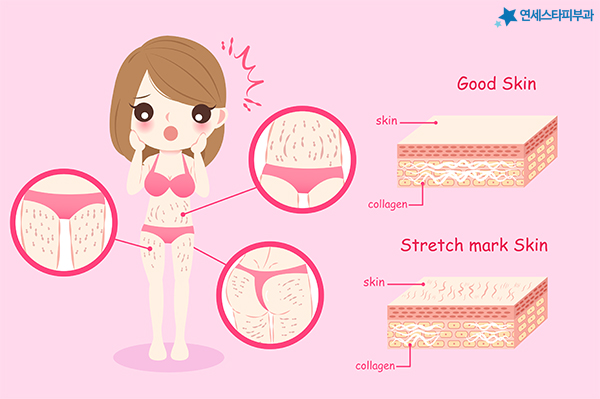
The skin consists of the outer epidermis and the dermis beneath it. The dermis is relatively less flexible, so it often cannot keep up with the rapid stretching that occurs with sudden growth in height or weight gain over a short period. This ultimately leads to the dermis tearing and leaving traces, which we commonly refer to as 'stretch marks'.
Why Are Ointments and Creams Insufficient?
Many people wish to resolve stretch marks by self-applying ointments or creams. However, it's difficult to see significant changes. Since existing stretch marks are akin to a type of scar, noticeable improvement is not easily achieved by simply applying something to the surface.

In particular, most creams are classified as cosmetics. While they can help keep the skin surface moisturized to some extent, looking at their ingredients, it's difficult to expect them to penetrate deep into the skin to aid in recovery.
Of course, in the early stages, moisturizing care alone can provide some help. Therefore, some people expect self-care to be sufficient, but it's important to remember that this is more of an auxiliary role to slightly reduce the likelihood of further progression, and there are clear limitations in reversing the marks that have already formed.

What's the Difference Between Red Stretch Marks and Old Stretch Marks?
Stretch marks change in color and texture over time. In the early stages, shortly after they appear, they have a reddish hue, but as time passes, they gradually turn white and settle.
| Category | Timing | Characteristics | Approach |
|---|---|---|---|
| Red Stretch Marks | Early | Reddish, inflammatory reaction still present | Primarily focused on managing progression |
| Old Stretch Marks (White Stretch Marks) | Late | Settled as white, accompanied by depressions and rough texture | Laser approach to stimulate collagen |
Since the management approach varies depending on the stage of the color, the first step is to check whether your stretch marks are red-stage stretch marks or white stretch marks that have settled as white.
Can Stretch Marks That Have Turned White Really Improve?
In the past, there was a strong perception that treatment was difficult once the color had already turned white. However, with accumulated research and clinical experience, it is reported that treatment approaches have advanced to the point where noticeable improvement can be expected, if not 100%.
Old stretch marks that have settled as white are no longer considered an untreatable stage, but rather an area where improvement can be attempted. However, individual results may vary.
Along with turning white, old stretch marks often show depressions, making the surface feel uneven and rough. As they are noticeable like indelible scars, they can lead to a drop in confidence and stress depending on their location.

How Do Lasers Work?
Lasers work by stimulating collagen deep within the skin with strong energy and using thermal energy to help fill in depressed areas. For old stretch marks with severe depressions, skin boosters may be used in conjunction to more effectively induce collagen production.
In the consultation room, even with white stretch marks, the approach often differs because individuals with deep depressions have a different starting point than those with shallow ones.

At Yonsei Star Dermatology Sinchon, we have adopted an approach that enhances satisfaction by combining the Pinhole Technique with CO2 lasers such as Ultrapulse Encore, inspired by the principles of scar treatment. It is considered advantageous for helping new skin grow relatively quickly and for allowing selective application to problematic areas, making it easier to return to daily life after treatment. We also combine Stretch Mark Treatment to refine scar texture and RePott Laser to fill in depressions, tailored to the condition.
If you are curious whether laser treatment is the right approach for your stretch marks, you are welcome to inquire easily through chat consultation for old stretch mark treatment directions.

Important Precautions to Know Before Treatment
Due to the use of high energy, there are points to check after treatment. Reviewing the items below in advance may be helpful.
- Temporary hyperpigmentation may be visible after treatment.
- Hyperpigmentation tends to occur more easily in areas like the calves and other leg regions.
- If depressions are deep, a staged approach may be taken rather than a single treatment.
- Daily care, such as sun protection and moisturizing, is important during the recovery process.
- Individual results may vary depending on the area and condition.
Because of these factors, especially for areas prone to hyperpigmentation, we recommend discussing thoroughly with experienced medical staff to minimize issues before starting treatment.

Time to Address Long-Standing Concerns
Old stretch marks are not traces that disappear overnight, but there's no need to conclude that they are beyond help. The key is to identify the stage of your stretch marks and calmly establish an appropriate treatment direction for your condition.
If you have long-standing concerns, you can start by easily inquiring through chat consultation for old stretch mark condition assessment.

For additional inquiries about old stretch marks, please contact us anytime via Kakao chat consultation or at 02-332-0023 for more detailed guidance. This has been Yonsei Star Dermatology Sinchon. Thank you.
Chief Director Lee Sang-joo (MD, PhD, Yonsei University College of Medicine and Graduate School, Completed Dermatology Residency at Severance Hospital, President of the Korean Society for Dermatology) Chief Director Lee Sang-joo's Profile First Published 2025-02-06 / Last Reviewed 2026-06-16
This article is for general informational purposes only. Even with the same stretch marks, individual conditions and recovery patterns may vary. Please consult with medical staff for an accurate diagnosis and treatment plan.