

Unlike other wounds, scars from burns often remain visible over time without fading. The most common question we hear is, "My burn scar has already hardened; can it still improve if I start now?" To answer directly, while it's difficult to fully restore the skin to its original state, consistent treatment with the laser Pinhole Technique is reported to improve the scar to a much softer and lighter condition than its current state.
Why Burn Scars Don't Disappear on Their Own
Typical wounds only damage part of the epidermis and dermis, fading naturally over time. However, burns cause thermal damage deep into the dermis, leading to the skin thickening and hardening during the healing process. In severe cases, contracture, where tissues pull together, can occur, causing discomfort in movement or leading to situations where one is desperate to hide the scar.
Burn scars involve deep dermal damage and abnormal collagen rearrangement, so an approach that only lightens the surface has limitations.
Due to these characteristics, burn scars are known as a challenging area to treat. Many people postpone visiting a hospital and experience stress, having only vaguely heard that it's difficult. In this article, we will outline the treatment directions available and explain how the Pinhole Technique works.

Surgical Treatment vs. Laser Treatment: What's the Difference?
Burn scar treatment can be broadly divided into surgical treatment, performed in surgery, and laser treatment. These two methods differ in their application and recovery process.
| Category | Surgical Treatment | Laser Treatment |
|---|---|---|
| Primary Application | Severe contracture or large areas | Improvement of surface texture, pigment, and hardness |
| Considerations | Surgical scars, possibility of keloids/hypertrophic scars | Requires multiple repeated treatments |
| Recovery | Relatively long recovery period | Relatively short return to daily life |
Surgical methods may be chosen for extensive scars or severe contractures. However, it's important to be aware that after scar removal surgery, depending on the skin type, it can lead to keloids or hypertrophic scars during the recovery process, potentially adding a surgical scar to the burn. Even after skin graft surgery, additional laser treatment is sometimes necessary due to the discrepancy between the surrounding skin and the grafted area.
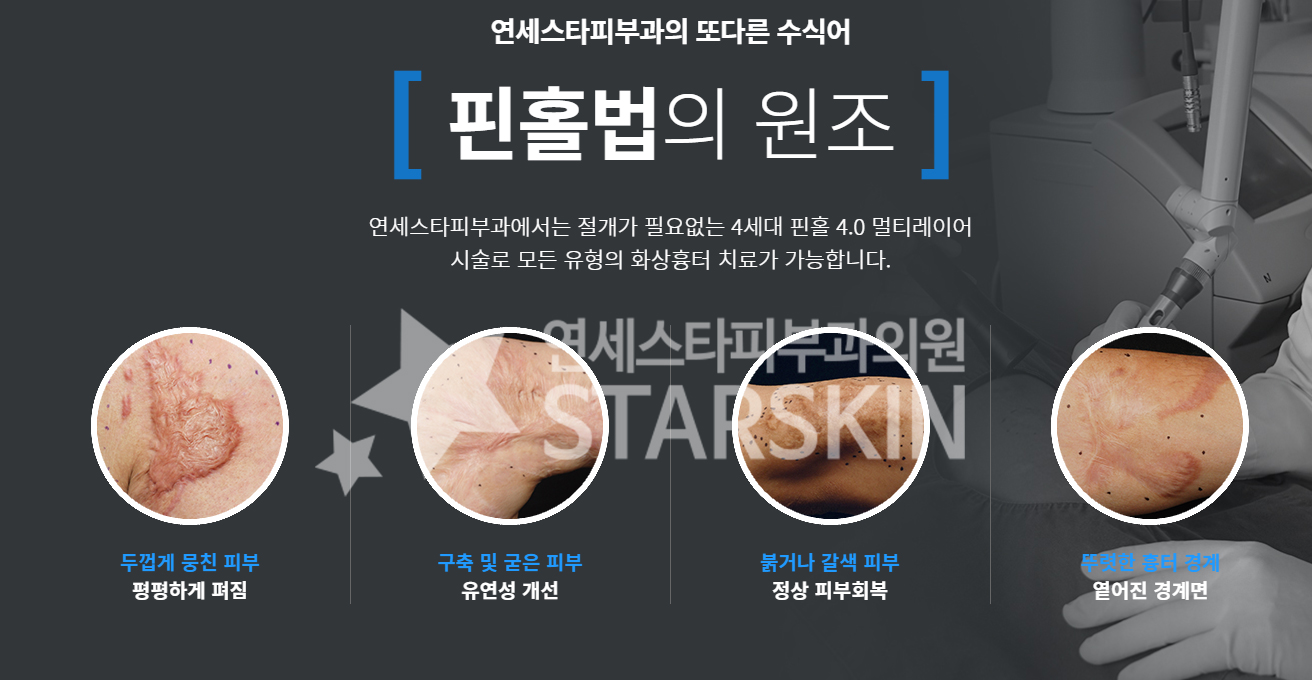
Yonsei Star Dermatology Sinchon uses the Ultrapulse Encore laser, known for its strong action among scar treatment lasers. When the laser is applied to the burn scar area, the beam penetrates deep into the skin, stimulating skin regeneration.

How Does the Pinhole Technique Work?
The Pinhole Technique, a widely known laser treatment for burn scars, has been performed at Yonsei Star Dermatology Sinchon since the early 2000s. After being reported at dermatology conferences worldwide, several clinical papers have also reported that the Pinhole Technique showed good results in treating burn scars.
In the consultation room, the most common question patients ask is, "Why does making holes improve the scar?" When microscopic holes are made in the burn area with the Ultrapulse Encore laser, the tangled and hardened tissue loosens and softens, inducing collagen to rearrange. This process is called the Pinhole Technique.
The actions of the Pinhole Technique can be summarized as follows:
- Micro-loosening of hardened scar tissue
- Inducing skin regeneration and collagen rearrangement
- Gradually improving texture and color through repeated treatments
- Approaching a state similar to the surrounding healthy skin
When this method is performed repeatedly, better results can be expected, and consistent treatment has been reported to achieve a level where the scar resembles the surrounding healthy skin. Similar approaches are also used for deep scars like surgical scars in addition to burn scars.
If you have any questions, please feel free to ask via chat consultation for burn scar Pinhole Technique treatment.

How Many Treatments and at What Intervals?
The Pinhole Technique is usually performed multiple times, with at least a 1-month interval between sessions. While it varies depending on the size and depth of the scar, it is generally reported that improved appearance can be observed after a minimum of 5 to 10 or more sessions. It is not a one-time treatment but a process of repetition, allowing time for the skin to recover and rearrange.
Here are some points to keep in mind before and after treatment:
- It is not a one-time treatment and involves multiple sessions.
- There is at least a 1-month interval between sessions.
- The number of sessions varies depending on the size, depth, and location of the scar.
- There may be individual differences in response and recovery speed depending on body type.
- All consultations and procedures are decided after thorough discussion one-on-one with a dermatologist.
All consultations and procedures are determined based on individual scar characteristics after direct consultation with a dermatologist, so we recommend scheduling a consultation first. If contracture is present, Surgical Scar Revision or Triamcinolone Scar Injection may also be considered.

Can Old Burn Scars Also Improve?
It is difficult to return completely to the original state. However, it is reported that treatment with the laser Pinhole Technique can improve the current condition by about 70-80%. Even very old burn scars have the potential to improve, so it is better to confirm your current condition through a consultation rather than worrying alone.
Burn scar laser treatment is a complex process, so not many dermatology clinics perform it. This is also why many people hesitate about where to start. You may find it helpful to refer to more detailed explanations about burn scars.
Just starting from your current state can be a step forward. If you want to learn more, please feel free to inquire below.
💬 Consult NowChief Director Dr. Sang-Joo Lee (MD, PhD, Yonsei University College of Medicine and Graduate School, completed dermatology residency at Severance Hospital, President of the Korean Dermatological Association) Chief Director Dr. Sang-Joo Lee's Profile First published 2024-01-08 / Last reviewed 2026-06-16
This content provides general medical information; treatment response and recovery speed may vary individually. For an accurate diagnosis and treatment plan, please consult with medical staff.